The simplest-looking pearls are not always the easiest to wear.
A pearl stud can look discreet in a product photo, then feel conspicuous beside a plain T-shirt. Size and setting matter as much as the pearl itself. Small studs, around 5–7 mm, tend to sit quietly against the ear; larger pearls or dangling settings make more of a statement.
For one pair worn often, a short post with a secure backing is usually more practical than a long drop that catches on collars or hair. Slightly irregular freshwater pearls can feel relaxed, while perfectly round, high-luster pearls often read dressier. Checking a photo of the earrings on an ear gives a better sense of scale than a close-up of the jewelry alone.
What makes pearl earrings look minimal?
- A clear outline
The pearl and its setting should read as one simple shape from a normal viewing distance. A small pearl can still look busy if it sits inside a decorative frame.
Look forAn uncluttered shape that is easy to take in at a glance.Watch forHalos, clusters, or settings that compete with the pearl. - Proportion on the ear
Size matters in relation to the earlobe, not just on a product page. A slightly larger pearl set close to the ear may look quieter than a tiny pearl on a long drop.
Look forA scale and length that feel balanced when worn.Watch forChoosing the smallest diameter without checking the full earring. - Quiet metalwork
A slim post or simple hook lets the pearl remain the focus. Thick rims and prominent hardware can make even a plain pearl feel ornate.
Look forMetal that supports rather than frames the pearl.Watch forHeavy settings or extra decorative details. - A finish that fits the wardrobe
A soft luster and a metal tone already common in everyday jewelry often make a pair easier to repeat. The aim is a natural fit with clothes in rotation, not a perfect match.
Look forPearls and metal that sit comfortably beside familiar pieces.Watch forA high-contrast finish reserved for one outfit.
How stud size looks on the ear
A pearl’s diameter is only part of its apparent size. A 6 mm pearl may look restrained on a broad lobe but cover much of a smaller one. Placement matters too: a stud close to the lobe’s lower edge can appear larger than the same stud worn nearer its center.
The setting changes the outline. A simple post leaves the pearl as the main visible shape, while a metal rim adds width. A raised cup can make the stud project farther from the ear, even when its front-facing diameter is unchanged.
For a useful comparison, check the listed diameter in millimeters and measure the visible width of the lobe. Then look for a modeled front view and a side view, ideally on ears with similar proportions. Words such as dainty are less reliable than seeing how much lobe remains visible around the stud.
Check comfort before committing
A pearl stud can look delicate in a photo and still feel awkward after a few hours. Before buying, inspect the parts that touch the ear as closely as the pearl itself. Product photos rarely show whether a post sits comfortably or a backing holds without pressure.
For sensitive ears, post composition matters more than a vague “hypoallergenic” label. Implant-grade titanium and niobium are options for people avoiding nickel; solid gold may suit some wearers, while plating can wear through. The guide to choosing posts for sensitive ears looks more closely at material options. Check whether the entire post, not just the visible setting, has a stated material.
A post that is too short may pinch the lobe; one that is too long can let the pearl tip forward. Backings matter too: a butterfly back should stay put without being pushed tightly against the ear, while a larger backing can steady a heavier stud.
- Look for post length and metal specifications, not just pearl diameter.
- Check the pair’s weight when listed; larger pearls and substantial settings can tug despite a clean silhouette.
- If possible, try the earrings on long enough to notice pressure or tilting.
Choose pearls that suit the clothes
Cultured pearls grow inside mollusks with human assistance; imitation pearls are typically glass or resin with a pearl-like coating. Both can make understated everyday earrings. A material description is more reliable than appearance alone, since a smooth cultured pearl and a well-made imitation can look similar in photos.
Shape and surface have a bigger effect on styling. Slightly off-round pearls or small natural markings bring a relaxed note that sits comfortably with linen, denim, and textured knits. Rounder pearls with even surfaces look more polished alongside crisp shirts, fine-gauge sweaters, or tailored clothes. Neither needs to be flawless to look considered.
Luster describes how light reflects from the surface. Bright, clear reflections make a pair look more defined; softer reflections create a quieter effect. For two-pearl earrings, check whether the pearls look harmonious side by side: similar size, shape, and color usually matter more than perfect uniformity. White, cream, and faint pink tones can read differently against the same fabric, so photos taken in daylight can be especially helpful when comparing a pair with an existing wardrobe.
Start with simple pearl studs
For a minimalist wardrobe, plain pearl studs make a strong first—and possibly only—pair. A white or soft cream pearl works with casual clothes and tailored pieces without asking for a matching necklace. For more examples of similarly restrained styles, see these studs suited to everyday outfits.
Look for a setting that is barely visible from the front. A wide metal cup, decorative prongs, or a rim of stones changes the effect even when the pearl itself is small. Around 6 mm is a useful size to try first, but the better test is whether the pearl sits neatly on the lobe without covering its edge.
The back deserves as much attention as the front. It needs to hold the stud close enough that the pearl faces forward rather than tipping down. A screw back offers a firmer closure, though it takes longer to fasten; a well-fitting push back may be simpler for frequent changes. Once fastened, the stud should stay level during ordinary movement.

These white cultured freshwater pearls sit on sterling silver posts, with no decorative detail competing for attention. Their 6 mm size offers a sensible starting point for a single everyday pair.
The threaded posts have screw backs and, according to the listing, are shortened. Check that they fasten fully and leave the pearls sitting level on the lobe.
When a small drop works better than a stud
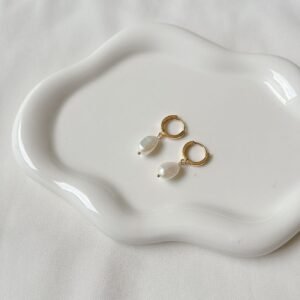
Studs sit close to the ear and tend to disappear into an outfit. A short pearl drop keeps the same spare look but moves slightly when the wearer turns, making a plain shirt or fine knit feel a little less conventional. The difference is noticeable without requiring a larger pearl.
The cleanest versions leave space between the lobe and pearl: a slim hook, a short chain, or a single bar can provide movement without adding bulk. For examples of that restrained approach, see pearl drops with movement rather than extra ornament.
Length and weight deserve a closer look than they do with studs. A drop that brushes a collar or pulls at the piercing may feel less effortless over a full day, even if it looks delicate in a photo. Product measurements and worn-on-ear images help establish where the pearl actually hangs. Studs remain the simpler default; short drops make sense when a little motion suits the clothes.
Pearl clip-ons for unpierced ears
Unpierced ears need not rule out a simple pearl stud. A small clip-on with discreet hardware can look much like a pierced pair from the front, though its fastening deserves just as much attention as the pearl. A delicate appearance offers little benefit if the earring slips during the day or pinches after an hour.
Fit matters more than a tight grip. Spring clips are quick to fasten, while adjustable screw clips allow finer control of pressure. A smooth contact surface or small cushion may feel gentler, but a bulky pad can make the pearl sit farther from the lobe.
For regular wear, clip-on pairs designed to stay put without pinching are worth comparing by clasp as well as appearance. Trying a pair while turning the head and putting on a collar can reveal slipping; persistent pressure is a reason to try a different fastening.
Try them with real outfits
A pearl earring can look formal in a product photo and relaxed beside a soft sweater. Before choosing a pair, try the same earrings with three outfits: plain knitwear, a crisp shirt, and something dressier. Looking at the whole outfit, rather than the ear alone, makes the difference easier to judge.
- With knitwear: Check whether the pearls add a quiet point of light or feel too polished for the fabric.
- With a shirt: Notice how the pearls sit beside the collar. A small stud may blend in, while a short drop can show below the hair.
- With dressier clothes: See whether the earrings still feel intentional without needing a matching necklace.
A quick mirror photo of each outfit can help: side-by-side images often reveal which pair gets worn naturally and which one seems to require a special occasion. Pearls are not automatically too formal; their effect depends on the setting and the clothes around them. For a closer look at that distinction, see how pearls work with everyday outfits.
The most-worn clothes should break the tie. If a pair looks lovely with a dress but out of place with the sweaters and shirts worn most weeks, a simpler pair is likely the more useful buy.
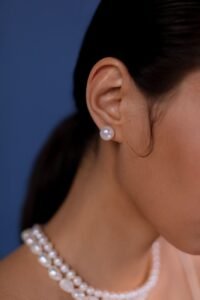
The final try-on check
A pearl earring can look understated in a product photo yet sit differently on the ear. In a mirror, check the front view for an even, balanced appearance, then turn sideways: a stud should rest against the lobe rather than tip forward, and a drop should hang without jutting out.
Next, walk a few steps and turn the head. A little movement is natural for drops, but repeated swinging into the neck or collar may make a pair less practical for daily wear. Gently check that each back stays in place without needing constant adjustment.
If possible, leave the earrings on through an ordinary stretch of the day. Tilting pearls, slipping backs, or drops that become uncomfortable are worth investigating as fit or construction issues—not quirks to ignore because the earrings look good in a mirror. A simpler-looking pair that sits securely and feels easy to wear is often the better wardrobe staple.
-
Start with familiar clothes
Picture the earrings with a weekday shirt and the outerwear worn most often, not just a special-occasion outfit.
-
Compare the whole earring
Check pearl diameter, setting width, and drop length against modeled views; a small pearl can still have a prominent setting.
-
Check the hardware
Look for a suitable post material, a secure backing, and a weight that feels manageable for regular wear.
-
Read the return terms
A clear return window makes it easier to judge scale and comfort at home.
The strongest choice is rarely the most striking pair in the listing. It is the pair that looks at home with familiar clothes and feels easy to put on again.