A bracelet has to feel as good on a Tuesday as it looks in a photograph.
At a keyboard, a loose bracelet can tap the desk with every keystroke; under a knit cuff, a raised setting may catch. A piece worn through commutes, errands, and workdays needs to be judged differently from one worn mainly to dinner.
Fit matters as much as appearance. The bracelet should move comfortably without sliding over the hand, and its clasp should be easy to fasten and secure once closed. Smaller pearls or a simple setting often sit more quietly alongside casual clothes. The useful question is not just whether the bracelet looks effortless, but whether it still feels that way hours later.
What makes a pearl bracelet easy to wear often?
- A fit that stays put
The bracelet should move a little without sliding over the hand or dropping onto the palm at a desk. Checking the fit with the wrist bent is more revealing than checking it while standing still.
Look forA little movement, with no slipping over the hand.AvoidA strand that catches under the palm or feels tight when the wrist bends. - Pearls that suit regular clothes
Smaller pearls tend to sit more quietly beside cuffs, knits, and casual sleeves. Larger pearls can work for everyday wear, but may feel bulky under a fitted sleeve.
Look forA scale that works with clothes worn most often.AvoidChoosing on appearance alone without trying the bracelet under a sleeve. - A clasp that is practical to use
A secure clasp is only useful if it can be fastened without a long struggle. Testing it one-handed gives a better sense of whether the bracelet will get worn regularly.
Look forA closure that fastens easily and stays shut.AvoidA tiny clasp that is difficult to grip. - Smooth finishing
Run a finger along the strand and near the clasp. Rough joins, protruding wire, or scratchy hardware can become irritating over a full day.
Look forEven spacing and smooth contact points.AvoidSharp edges or hardware that snags fabric.
A bracelet can be comfortable for frequent wear without being suited to every activity. Taking it off before showers, exercise, or cleaning helps keep pearls away from water, chemicals, and repeated knocks.
Choose the shape that feels right
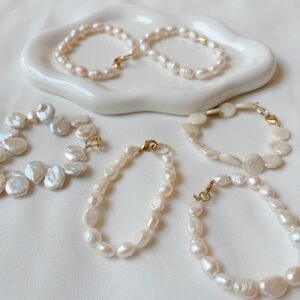
Even with similar pearls, these three styles make different impressions on the wrist. The choice is less about which is best and more about how much presence and movement feels comfortable through an ordinary day.
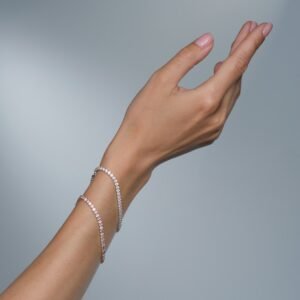
- Sparse pearl chain: Pearls spaced along a fine chain look light and leave plenty of bare wrist visible. The chain usually moves freely, which can feel easy under a sleeve, though a loose fit may let the pearls slide out of view or catch on a bag strap. This is a good starting point for someone who prefers a subtle bracelet.
- Continuous strand: Pearls all the way around create a fuller, more noticeable line. A strand drapes and shifts as the hand moves, so it feels less fixed than a cuff; larger pearls can also sit higher against a shirt cuff or desk. Smaller pearls generally give the same silhouette a quieter look.
- Pearl-accented cuff: A metal band with one or a few pearls keeps a defined shape and has less dangling movement. It can feel neat with rolled sleeves, but its rigid edge may press against the wrist at a keyboard. Unlike a chain or strand, it has little room to adjust: a cuff that fits without shifting matters as much as its appearance.
For a low-key look, the chain has the least visual weight. A strand makes pearls the main feature; a cuff offers a sharper outline. Trying each on while moving the hand can reveal which kind of movement feels least distracting.
Look past the pearl photo
A close-up can make a tiny pearl look substantial and a textured one look perfectly smooth. Check the listed diameter in millimeters, then look for a photo on a wrist or beside a ruler. Freshwater pearls around 4–6 mm tend to read as delicate accents; larger pearls become more noticeable and may be easier to feel against a desk or sleeve.
Freshwater pearls often have slight differences in shape, color, and surface. Small dimples or uneven curves can give a bracelet character, particularly when the pearls look harmonious together. More useful questions are whether rough-looking areas sit where they could rub the skin, and whether the listing shows the actual bracelet rather than only a representative sample.
Construction deserves the same attention as the pearls. For a chain bracelet, look closely at link thickness, the rings joining pearls to the chain, and the connection between clasp and bracelet. Descriptions should clarify whether those small attachments use the same metal as the chain; a gold-filled chain does not automatically mean every finding is gold-filled. The details worth checking on a gold-filled pearl chain matter especially when the bracelet will be fastened and handled often.
For a full strand, check whether pearls are knotted on thread or strung on wire, and how the ends meet the clasp. Knots can keep pearls from rubbing directly against one another and help contain them if the thread breaks. Neither construction is maintenance-free: thread can stretch, while wire and attachment points can fatigue. A listing that names these materials and shows the ends clearly offers more to judge than a polished front-view photo.
Find a fit that stays comfortable
Wrist circumference is the measurement around the wrist; finished bracelet length is the measurement of the bracelet from end to end, including its clasp. They are not interchangeable. A bracelet needs room to fasten and move, but the right amount depends on its construction and how it feels in use.
A fine chain and a pearl strand can feel different even when both have the same listed length. The chain lies close to the skin, while the pearls take up space on the inside of the strand. Larger pearls can make that difference more noticeable. When comparing listings, check whether the stated length includes the clasp and whether an adjustable chain offers several fastening points.
To judge fit, watch what happens during ordinary movement:
- If the bracelet slides over the hand without opening, it is too loose to stay secure.
- If pearls repeatedly travel beneath the wrist or knock against a desk, there may be more movement than is comfortable for daily wear.
- On a small wrist, a long adjustable tail can dangle even when the bracelet itself is fastened snugly.
A comfortable bracelet can shift slightly without constantly needing to be pushed back into place. For a strand, checking the wearable fit matters more than choosing by the listed length alone.
Closures
Tiny lobster clasps hinder solo fastening; larger ones grip. Adjustable chains and extenders ease tight fits, but tails dangle. Open cuffs slip on or off. Check closure photos and adjustment range.
Easy-wear pearl bracelets
Rubi Diy Crafts makes an easy-wear pearl bracelet.
Check for snags and shifting
Product photos reveal more than the pearl’s finish. Zoom in on side views and the underside of settings: raised prongs, rough link joins, exposed wire ends, and dangling tails can catch a knit cuff. A front-only image may hide the parts most likely to meet a sleeve.
Reviews can fill that gap, especially when they mention sweaters or hair catching in the hardware. Look for repeated accounts and compare customer photos with the listing images. The small details behind sleeve snags are often metal components rather than the pearls themselves.
Check where the weight sits, too. A large focal pearl opposite a light clasp can pull the bracelet around; a heavy clasp may do the same in reverse. Extra room in the fit lets that movement become a full turn, leaving the pearl or clasp beneath the wrist.
Photos taken during wear may show whether the centerpiece stays visible. Comments about frequent readjustment are another clue that a bracelet that keeps turning has a balance or fit issue, even if it looks well arranged in a flat-lay photo.
Choose the look that fits daily life
For an understated default, choose a chain with a few small pearls spaced along it. It adds a little light without reading as a full pearl bracelet. For more visible pearls, a fine strand gives a continuous line around the wrist while remaining easy to pair with casual clothes. The roundup of less-dressy options offers more starting points for a low-key look.
An open cuff suits someone who dislikes working a clasp, provided its shape fits the wrist comfortably. It is worth assessing the opening and how securely the cuff stays in place before making it a daily choice. A cuff that feels too loose can shift during ordinary tasks.
When the bracelet is a gift and wrist size is unknown, adjustability is a separate advantage from style. A sliding closure or short extender allows some room to find a comfortable fit. The guide to adjustable gift options looks more closely at that trade-off.

This spaced-pearl chain keeps the look lighter than a full strand. Its listing describes 5–6 mm cultured pearls and a sliding closure.
The adjustable chain makes it worth considering when the recipient’s wrist size is unknown. Check the listed measurements rather than assuming one adjustable bracelet fits every wrist.
Wear it with everyday clothes
A pearl bracelet does not need matching earrings to look intentional. A slim chain with a few pearls can peek out beneath a rolled cotton cuff; a fine strand can sit beside a plain watch without competing with its face. A little bare wrist between the bracelet and watch keeps both visible and helps limit rubbing.
For a minimal bracelet stack, let either the pearls or the watch be the focal point, then add no more than one narrow, quiet band. Similar metal tones can tie the pieces together, but exact matches are unnecessary. After wear, gently wipe pearls with a soft cloth. Put them on after applying cosmetics, and remove them before washing or swimming.
-
Choose a silhouette
A small-pearl chain is a useful starting point; a strand or cuff may suit someone who prefers more presence.
-
Inspect materials and construction
Look at the metal, strand or chain, and connection points—not just the pearls.
-
Check fit and closure
Allow for pearl volume, then consider whether the clasp is easy to fasten and stays secure.
-
Check for snags and rotation
Sleeves, desk edges, and a loose fit can expose problems that photos miss.
The best choice is the bracelet its wearer will reach for on an ordinary day, even if another looks more striking in a box.