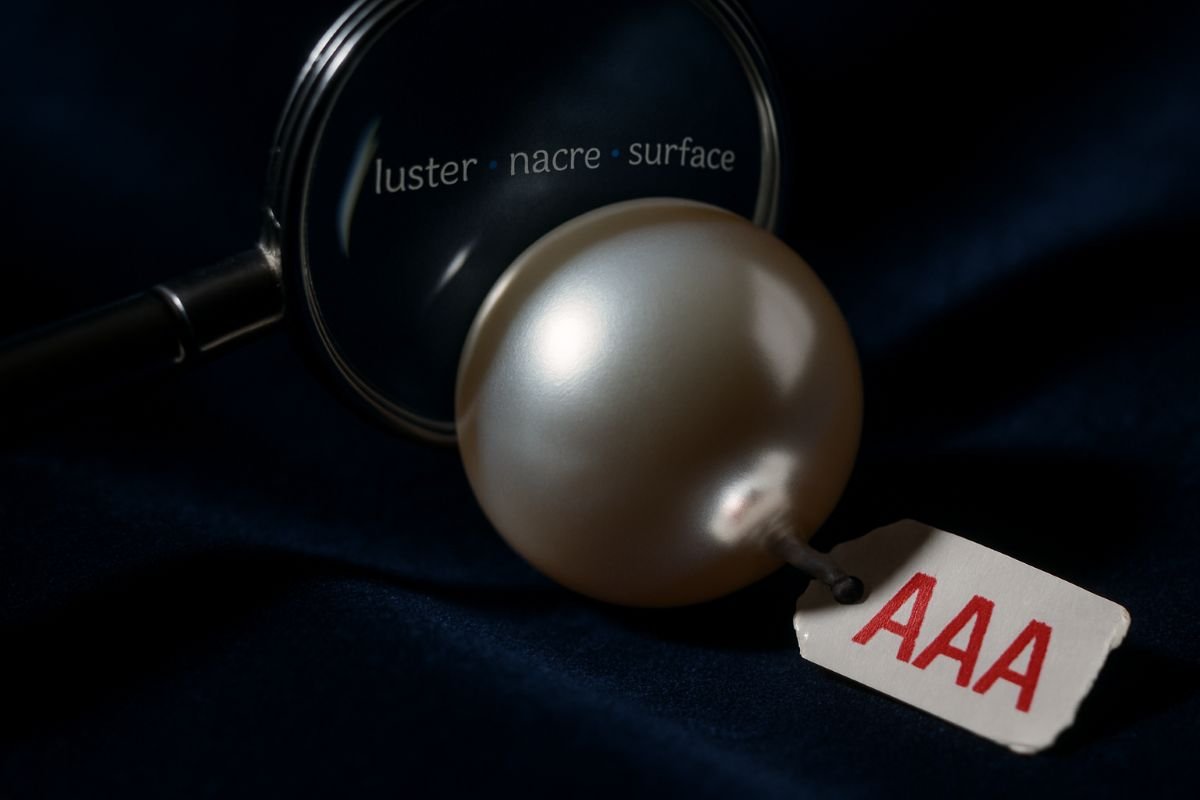
The Mirage of Pearl Grades
Why a letter means less than you think
Pearl grades look scientific. AAA, AA, A—neat letters arranged to imply a measured system. The truth is less comforting. There is no universally accepted grading standard for pearls. Each seller crafts a proprietary rubric, then applies it within the context of their own inventory and price range.
That means the letter on a tag says more about the seller’s internal sorting than the pearl itself. A strand labeled AAA by one company might be equivalent to AA for a competitor working with a higher-quality lot. At wholesale, pearls come in a continuum of quality and price; retailers carve that continuum into tidy boxes that suit their branding and margins.
Letters simplify. They also mislead.
How this confusion was engineered
Confusion is not an accident here; it is a feature. Turning a spectrum of attributes—luster, surface, nacre thickness, shape, matching—into a single letter obscures trade-offs and narrows comparison. It keeps consumers focused on grade labels instead of asking deeper questions that would challenge pricing.
Proprietary systems also block cross-shop comparisons. If “AAA” means one thing on one site and something else on another, who benefits? Not the buyer. The seller does, because the buyer’s uncertainty often ends in paying the premium attached to a letter rather than the inherent qualities of the pearls.
The Unregulated Market
How wholesale sorting actually happens
At wholesale, pearls are presented in trays that vary across multiple axes. Buyers choose within bands of quality and cost, grouping pearls into tiers that feel coherent for their audience. There is judgment involved. Two buyers standing over the same lot can walk away with entirely different interpretations—and entirely different labels for what they bought.
The lack of a central standard leaves plenty of room for subjective decisions. Some buyers will prioritize luster and accept slightly more spotting. Others will accept softer luster if the surface is cleaner and the matching is tighter across a strand. Both might call their choices AAA.
Letter grades as marketing shorthand
A single letter is tidy copy. It collapses a dozen variables into something easy to sell and quick to understand. The shorthand saves space on a product page and shortens sales conversations. It also glosses over the reasons two similarly labeled items can look—and be—vastly different.
Shortcuts help sales. They hurt clarity.
AAA Today AA Tomorrow
Variability across sellers and price bands
The grade depends on the pool from which it was drawn. If Seller A is sourcing from a mid-range lot, their highest grade might top out at what Seller B would consider mid-tier. The letter is relative, not absolute. Move up a price band, and your “AAA” suddenly looks like yesterday’s “AA.”
This relativity also plays out within a seller’s catalog. The best “AAA” freshwater strand might still be outclassed by that same seller’s lower-graded saltwater strand, because the underlying material differs. Letters often hide those context shifts.
When a top grade fails another seller’s minimum
It happens. One retailer’s “best” can fall short of another’s floor. Buyers who cross-shop intensely learn this the hard way: the grade is not a guarantee; it is a positioning tool. If that feels like smoke and mirrors, you’re reading it correctly.
Incentives and Information Asymmetry
Why proprietary systems persist
Retailers want control over their messaging and margins. A homegrown grading system delivers both. It creates a moat: you cannot easily compare their pearls with a competitor’s without stepping beyond letters into the specifics. Many shoppers never get that far.
There is also a defensive angle. If a seller tightens their standards and calls something AA+ that rivals would call AAA, they can claim restraint and integrity. If a different seller inflates their labels, they can claim superior access. Neither claim can be tested by the letters alone.
How confusion sustains margins
Confusion slows price pressure. When consumers cannot compare like with like, they cannot push back effectively on pricing. The result is a wider range of acceptable markups because the benchmark is foggy. Letters shield the spread between intrinsic pearl quality and the premium attached at checkout.
The fog is profitable.
What Really Determines Pearl Quality
Luster, surface, and nacre thickness
Luster is the heartbeat of a pearl: the sharpness and intensity of reflected light. High luster produces crisp reflections and depth that feels almost liquid. Surface refers to blemishes—pits, bumps, spots—that interrupt that reflection. Nacre thickness underpins durability and depth of glow; thin nacre can read “glassy” and age poorly.
These three are the core. They deserve more attention than any letter.
Shape, size, matching, and origin
Shape ranges from perfectly round to baroque. Perfectly round is rare and generally costly, but strong luster can make slightly off-round shapes look sensational. Size influences price exponentially; a strong 8–9 mm pearl may outshine a larger but duller one. Matching matters most for strands and earrings; consistency in tone, luster, and blemishing drives visual harmony.
Origin adds context. Akoya often leans toward bright, mirror-like luster. South Sea pearls trend larger with a softer glow. Tahitian pearls offer natural dark hues and overtones. Freshwater pearls vary widely and can deliver excellent value, especially in near-rounds with high luster. None of these realities map cleanly onto letters.
Why these rarely map cleanly to letters
Because a single letter cannot show the compromises. A strand might have exceptional luster but a few visible spots, or flawless surfaces with softer glow. Which letter wins? The answer changes by seller, by batch, by marketing goals.
Letters flatten nuance.
Vetting a Seller
Reputation signals and track record
Look for longevity, consistent reviews that reference actual pearl attributes, and repeat buyers who comment on pieces over time. Educational content that teaches you to judge pearls—rather than steer you back to grades—is a positive sign. Trade relationships and sourcing transparency also count.
Word-of-mouth trumps taglines.
Guarantees, returns, and third-party options
Clear return windows and no-restocking policies are confidence indicators. Look for warranties that address nacre wear or coating issues where applicable. If possible, verify whether independent appraisal or gemological inspection is welcome. Sellers who stand behind product rarely fear scrutiny.
Photography policies and disclosure practices
Insist on high-resolution, true-to-life images. Ask whether photos represent the specific piece or a sample. Request multiple angles and lighting conditions. Honest listings disclose surface marks, overtones, undertones, and any treatments. The more a listing has to say beyond a letter, the safer you are.
A Practical Buying Framework
Compare across vendors without relying on grades
Build your own checklist:
– Luster quality: sharp, bright reflections or hazy and soft?
– Surface: count the visible blemishes under normal viewing distance.
– Nacre: ask for thickness data when possible; inspect the depth of glow.
– Matching: especially on strands, assess consistency of luster, tone, and size.
– Shape and size: weigh how these choices affect price versus visual return.
Then compare the actual pearls, not the labels.
Questions to ask before you pay
– Are the photos of the exact item?
– What is the return and warranty policy?
– Has the pearl been treated or color-enhanced?
– What are the dominant overtones and undertones?
– For strands: how many blemishes are visible from arm’s length?
– For Akoya: is nacre thickness disclosed or guaranteed?
Probe politely. Vague answers are revealing.
Red flags that should stop the purchase
– Reliance on letters without detailed descriptions.
– Stock photos only, no item-specific imagery.
– Aggressive claims of “flawless” across entire strands.
– Evasive responses on returns, treatments, or nacre.
– Prices that are outlier-low relative to peers with similar details.
Walk away if you feel rushed.
Pricing Realities by Pearl Type
How price bands distort grade labels
Within each pearl type, prices escalate with size, luster, and scarcity. Sellers often stretch grade labels to justify band jumps. A mid-quality pearl might gain a higher letter at a higher price tier simply to align with the story the price needs to tell. That’s marketing pressure, not gemology.
Akoya, South Sea, Tahitian, and Freshwater differences
Akoya pearls are typically smaller to mid-sized with strong, mirror-like luster when well-made. Thin nacre is a risk at the low end; ask questions. South Sea pearls (white or golden) are large and scarce, with premium pricing and softer, luxurious glow. Surface character can vary; big sizes magnify flaws, so careful inspection matters.
Tahitian pearls bring natural dark body colors with peacock, green, aubergine, or silver overtones. Color quality and luster swing prices dramatically. Freshwater pearls span a huge range, from budget to excellent. Advances in cultivation have produced near-round strands with impressive luster, still often priced below comparable saltwater options. Across all types, the letter printed on a card rarely predicts the true hierarchy of value.
Myths to Retire
AAA equals flawless
It does not. Even very high-grade pearls usually carry minor blemishes, especially on larger sizes. “Flawless” is a sales adjective more than a realistic promise.
A single grading scale fits all pearls
Different species, sizes, and cultivation contexts make a universal scale improbable without detailed sub-criteria. Attempting to squeeze everything under one roof creates shortcuts and confusion.
Higher letters always justify higher price
Price should follow luster, nacre, surface, size, and rarity—not a letter. If the visual and structural qualities are not superior, the premium is air.
Pushing for Better Standards
What a useful guideline could include
A workable guideline would define terms precisely and separate attributes:
– Luster scores based on reflection sharpness and contrast at set distances.
– Surface grading that counts and categorizes blemishes per area.
– Minimum nacre thresholds by type and size category.
– Transparent notation for treatments and color enhancements.
– Matching criteria specific to strands and pairs.
No single letter. A profile instead.
What consumers can demand right now
Ask for measurement-like descriptions, not just adjectives. Push for actual-item photos. Request nacre info where relevant. Insist on return and warranty clarity in writing. And most of all, reward sellers who disclose trade-offs honestly; make that honesty win sales.
Money talks. So do refusals to buy vague product.
Conclusion: Choose Trust Over Letters
Grades are cheap.
The hard work is evaluation: luster, surface, nacre, shape, size, matching, origin, and whether the vendor shows you the pearl rather than hiding behind a label. The industry’s letter soup exists because it protects margins and compresses nuance. You can cut through it.
Choose the seller who earns trust through transparency and consistent product quality. Compare pearls against your own checklist, not a single letter. Pay for what you can see and verify. Leave the alphabet to the marketing department. Your eyes—and a good return policy—are better guides.