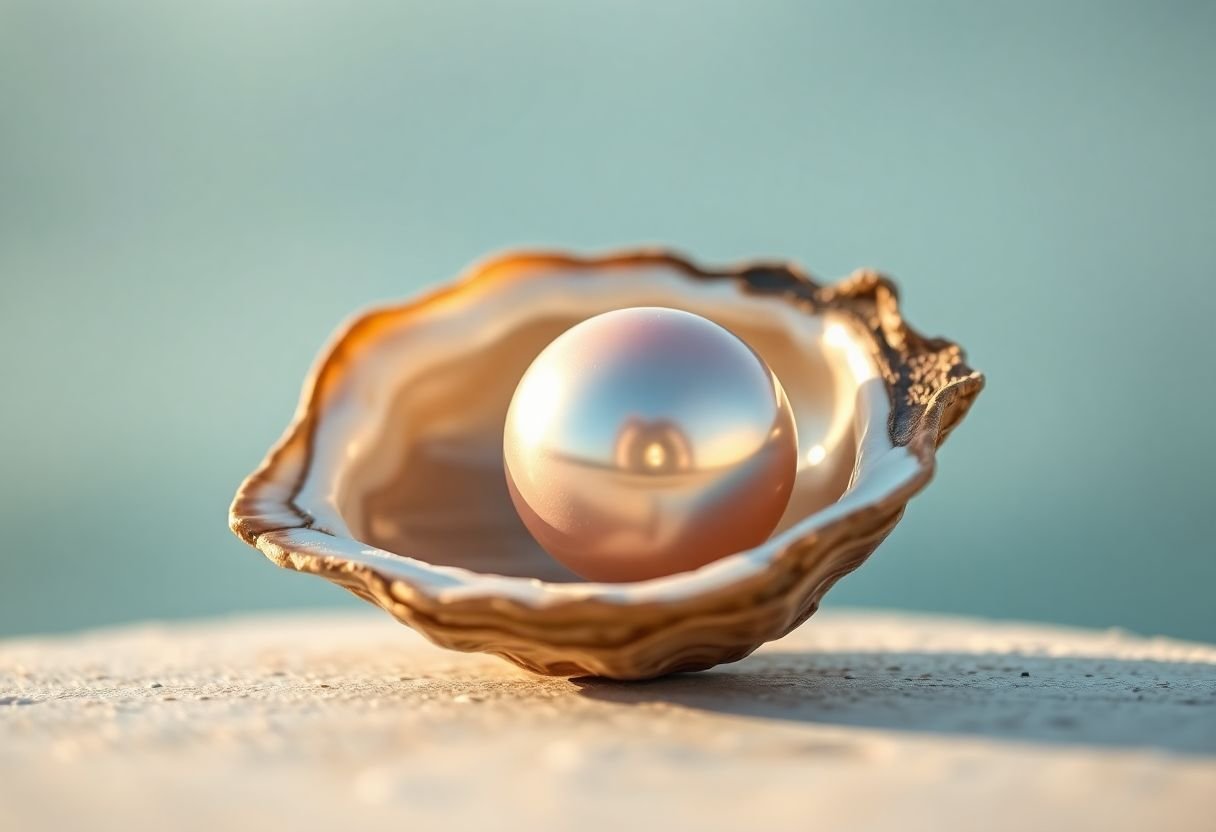
A World Before Cultured Pearls
For centuries, pearls were the sea’s rarest whisper. A perfect round gem born by chance inside a mollusk was as improbable as it was prized. Divers sank into deep, unpredictable waters to gather oysters, chasing a gleam that might never appear. Many dives ended with empty hands, and the few pearls found were cherished, hoarded, and traded between courts and collectors.
The gem’s mystique came from this scarcity. A single strand could reflect decades of fortune and risk. Natural pearls moved slowly—across oceans, through guarded hands, into royal coffers—becoming symbols of privilege and inheritance.
Every pearl was a story of luck.
Kokichi Mikimoto and a Vision from the Sea
He stood on Japan’s shore, watching tide and wind measure out time. Pearls had long enchanted his country, yet the waters yielded so few. Kokichi Mikimoto imagined something audacious: guiding nature to form pearls more reliably, while preserving their beauty. Not replacing the ocean’s artistry, but courting it with care.
His idea would change the horizon for jewelers and wearers alike.
Early Experiments and Setbacks
The work began in the late 19th century on Japan’s quiet bays. Oysters were suspended in rafts, tended like orchards. Mikimoto and collaborators tried countless approaches—introducing tiny irritants, pieces of mantle tissue, and varying methods to coax nacre to build and build again. Many oysters perished. Many trials failed.
Storms tore through farm structures. Disease swept through shellfish. Skeptics raised eyebrows at discolored or irregular results. There was imitation and controversy, too, as others rushed to patent techniques or claim success. Progress moved in inches, then stalled.
Still, he persisted.
The Breakthrough That Changed Everything
Patience, meticulous observation, and gradual refinements brought a turning point in the early 1900s. Controlled insertion of a nucleus, paired with a sliver of mantle tissue from a donor oyster, encouraged the growth of consistent layers of nacre. Over months and years, oysters deposited microscopic aragonite platelets and organic material, creating the soft glow that defines a pearl.
Round pearls began to emerge reliably. Not from chance, but from craft guided by biology. Pearl culturing had stepped out of speculation and into daily practice. The sea had a partner.
From Rarity to Reach
As farmed pearls proved their beauty and stability, a gem once reserved for a few began to appear in shop windows and small boxes on dresser tops. Quality could be scaled with care. The sight of a luminous strand no longer meant a royal pedigree—it could mark a graduation, a wedding, or a gift between friends.
Household names formed around this success. Techniques matured. Oyster farmers became stewards and specialists, turning calm coves and bays into living workshops of nacre.
The glow traveled widely.
Pearls Become Accessible to a Wider World
With cultivation, production costs lowered and consistency improved. Retailers could offer sizes, colors, and styles that suited many budgets. Department stores and jewelers introduced strands and studs to shoppers who had only read about pearls in magazines.
Accessibility didn’t lessen the gem’s romance. It widened the circle of wearers.
Shifts in Style, Status, and Symbolism
The pearl’s story expanded beyond court portraits and rare heirlooms. In the mid-20th century, actresses and public figures wore pearls with day dresses and evening gowns. Designers began pairing them with tailored suits, cashmere sweaters, or even denim. Minimalist studs appeared beside classic ropes. Long opera-length strands were looped and knotted, playful and poised at once.
The meaning changed, too. Purity and wealth gave way to ideas of quiet confidence, personal style, and modern grace. A pearl could be formal or casual, heirloom or self-purchase. It fit many lives.
Types of Cultured Pearls
Pearl types vary by oyster, water, and technique. Each carries its own character, from mirror-bright rounds to organic, rippled forms that catch the light in unexpected ways.
Akoya Elegance
Akoya pearls—most closely linked with Japan—are known for their classic, high-reflective luster and round shapes. Typically ranging from about 5 to 9 millimeters, they often appear in crisp whites and creams, with overtones of rose, silver, or faint ivory. When well-grown, their surfaces can appear almost glassy, offering that unmistakable mirror glance.
The traditional single strand of Akoya pearls remains a wardrobe staple for many. Simple. Refined.
Freshwater Variety
Freshwater pearls, grown primarily in lakes and rivers—especially across China—bring abundant diversity. Because many freshwater pearls are tissue-nucleated, they can form without a solid bead at the center, resulting in gems composed almost entirely of nacre. Shapes can be round, near-round, oval, button, coin, or baroque, each with a distinct personality.
Colors span gentle pinks, peaches, lavenders, and creamy whites. The range invites creativity, from playful arrangements to elegant, uniform strands. Freshwater pearls offer breadth and warmth.
South Sea and Tahitian drama
South Sea pearls, grown in the warm waters off Australia, Indonesia, and the Philippines, are admired for their grand scale and satiny glow. Sizes often reach 12 millimeters and above. White and golden hues dominate, with the famed golden tones coming from certain strains of the Pinctada maxima oyster. Their luster is soft and enveloping, like candlelight on silk.
Tahitian pearls, cultivated mostly in French Polynesia, come from the black-lipped oyster and brim with deep shades—charcoal, silver, peacock green, aubergine, and blue. Overtones can seem to float just beneath the surface. They carry mood and shadow, a sea at dusk.
Craftsmanship and Grading
A pearl’s beauty forms in layers, yet its appeal is read at a glance. Grading brings order to that instant impression.
Luster, surface, shape, and color
Luster is the soul of a pearl. It describes how light reflects and refracts from within, producing either a crisp, mirror-like shine or a softer glow. High luster displays sharp reflections and a sense of depth; lower luster appears hazier.
Surface quality notes blemishes, pits, or growth marks. Few pearls are flawless, but the distribution and visibility of imperfections affect value. Shape ranges from perfect rounds to baroques with lively contours. Round and near-round pearls are traditional favorites, while baroque forms can feel artistic and bold.
Color involves body color and overtone. Body color is the base—white, cream, pink, golden, gray, black. Overtones shimmer above it: rose, silver, green, blue. Matching a desired tone can become an art in itself.
Matching and the Art of the Strand
Creating a strand is like setting a rhythm. Each pearl must converse with its neighbors. Size, color, overtone, luster, and surface need harmony from clasp to clasp. In uniformly matched strands, the goal is visual unity without monotony. Graduated strands, on the other hand, rise from small to large pearls, creating a gentle arc that flatters the neckline.
Stringing is careful work. Knots placed between pearls prevent friction and loss, while chosen thread colors subtly influence the look. A good clasp complements the strand’s style and weight. Every detail supports the glow.
Places and Waters
Pearls are born of place. Water temperature, salinity, plankton, and currents leave fingerprints in nacre.
Japanese Bays and the Birth of an Industry
Japan’s sheltered bays provided a cradle for early pearl farms. Calm waters allowed rafts and cages to remain stable through the seasons. Craftspeople observed growth patterns, water clarity, and feeding cycles, refining techniques year by year. Entire communities learned to read the sea—to know when to clean shells, when to thin populations, and when to wait.
Waiting matters in pearl culture. Months turn to years before harvest.
A Global Network of Pearl Farms
As methods spread, farms took root across the Pacific and Indian Oceans, and in freshwater systems worldwide. From the lagoons of French Polynesia to the coasts of northern Australia, from Philippine inlets to Chinese lakes, each site brought different strengths. Larger oysters produced grand pearls; cooler waters yielded sharper luster; nutrient-rich environments encouraged steady growth.
Global trade shaped the market. Shipments of seed oysters, careful record-keeping of donor lines, and shared research improved outcomes and diversified supply.
Nature and Nurture
Every cultured pearl relies on a healthy mollusk and a clean environment. Biology sets the rules; human care follows them.
Environmental Stewardship and Clean Waters
Oysters are sensitive barometers of water quality. Excess pollution, sediment, or harmful algal blooms can halt growth or damage entire cohorts. For farms to succeed, bays must remain clear and balanced. That need fosters protective habits: monitoring runoff, limiting coastal disturbance, and managing waste with care.
Good water is visible in the pearl. Clarity outside becomes clarity within.
Sustainable Practices and Challenges
Producers face shifting currents, stronger storms, and changing ocean chemistry. Predators and diseases can surge. Responsible farms adapt by spacing oysters to reduce stress, rotating sites, and using hatcheries to support genetic diversity without overharvesting wild stocks. Collection and recycling of shells, careful energy use, and community partnerships further support long-term health.
None of this is simple. Yet the reward—resilient waters and stable livelihoods—keeps the work mindful and forward-looking.
Legacy and Influence
From a single idea on a windy shore, an industry grew that shaped jewelry design, retail, and cultural memory. The pearl found new homes and new meanings, generation after generation.
Mikimoto’s Imprint on Culture and Craft
Kokichi Mikimoto became synonymous with cultured pearls, his name etched into storefronts and stories. His pursuit brought precision to an age-old gem, building bridges between science, seafaring skill, and craftsmanship. Schools of workers learned to graft, clean, grade, and string with astonishing consistency. Brands formed identities around the glow.
The result feels both intimate and vast—a personal jewel, a shared craft.
Pearls in Contemporary Design
Designers today treat pearls with fresh eyes. Mismatched earrings combine baroque shapes with sleek metals. Oversized South Sea pearls sit on sculptural chokers. Tiny seed pearls line minimalist hoops. Strands are layered with chains and colored cords. Men wear pearls with tailored jackets and streetwear. Bridal jewelry ranges from classic collars to luminous hairpins.
Color-play stands out. Silver-white Akoyas might be paired with peacock-toned Tahitians, while golden South Sea pearls glow against oxidized silver. The gem’s quiet light holds its own beside diamonds and colored stones, creating pieces that feel modern yet familiar.
A Luminous Legacy
From chance-born ocean gems to carefully tended harvests, the story of pearls carries salt, patience, and human hope. The early vision that guided oysters to form nacre on cue opened the door for millions to experience that soft, inner light. Across wrists and necks, in heirloom boxes and new studio showcases, pearls continue to speak in a gentle voice.
They still feel like water made visible.
And they still catch the eye with a calm unlike any other gem.