A Shell That Shimmers: Understanding the Osmena Pearl
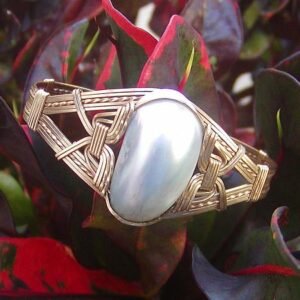 The first glance steals a breath. A dome of silver-blue shimmer, brushed with waves of lavender or sea-green, seems to hold a portion of tide and sky. Jewelers call it an Osmena pearl—a name that suggests ocean-born mystery, hand-polished and ready to catch the light.
It is cool to the touch. Smooth as rain-washed stone. Yet alive with movement beneath the surface.
That shifting glow is the signature of carved nautilus shell, patiently shaped into cabochons that glint like small moons. The look is unmistakable. The origin is surprisingly specific.
What an Osmena Pearl Really Is
Formation Within the Nautilus Shell
The chambered nautilus carries a coiled shell of remarkable geometry. Inside, the shell’s inner layer forms a pearly lining of aragonite—the same mineral base found in many mollusks—laid down in thin, lustrous layers. As the nautilus grows, new walls form and the spiral deepens, creating broad, curved sections with a sheen that catches light at every angle.
From these thicker inner curves, artisans cut segments and carve them into domes, teardrops, and ovals. Each cut reveals more of the subtle “flame” figure hidden beneath the bright surface. With careful shaping, the pattern blooms. Under a moving light, it ripples like heat in desert air.
The raw shell looks plain until the lapidary wheel wakes it.
Why It Is Not a True Pearl
Despite the name, an Osmena “pearl” is not a pearl in the strict sense. A true pearl grows within the soft tissue of a mollusk around an irritant, building concentric layers. The Osmena material does not form as a spheroid in tissue; it is carved directly from the inner shell lining of the nautilus. It’s a shell gem, not a pearl.
The label is a trade nickname. Beautiful, but a misnomer.
The Science of Nacre and Iridescence
Aragonite Platelets and Light Play
The nautilus inner shell owes its glow to aragonite, a crystalline form of calcium carbonate. In many mollusks, aragonite platelets stack in microscopic layers. When light enters, it bounces between these layers, splitting and interfering so that certain wavelengths strengthen and others fade. This optical stacking produces soft rainbows, a phenomenon often called structural color.
The nautilus has its own twist on the theme. Its inner shell is not classic nacre like an oyster’s mother-of-pearl, yet it still uses aragonite arranged in thin layers that bend and scatter light. Under magnification the structure differs, but the eye sees what it yearns for: liquid glow, cool fire, movement.
The effect is gentle. It never shouts.
The Flame Pattern of Nautilus
Distinctive, low-contrast waves curl across the surface, like wind passing over water. Jewelers call this the flame pattern. Instead of sharp dots or broad patches, you see meandering bands that flicker from gray to violet, from pale aqua to pearly white.
Rotate the stone and new lines melt into view. Subtle waves appear and fade.
The pattern is strongest where the shell layers curve most. That’s one reason cutters treasure pieces near the coil’s deeper sweep.
Colors, Textures and Luster
Osmena cabochons usually show a palette of silvery gray lit with lavender, pink, and sea-glass green. Under warm light, hints of peach and cream surface; under cool light, blue and teal take the lead. Some pieces are naturally quiet and misty; others show broad lanes of color that almost glow.
Many stones in the marketplace are dyed to heighten blues and purples. The result can be dramatic, even electric. Natural, undyed pieces lean soft and smoky, with a more whispered shift of tones.
The surface polish is key. Properly finished, it mirrors the world while holding its own inner gleam. Touch reveals a satiny slickness, almost velvety at the same time.
Crafting the Cabochon
Shaping Domes and Drops
Cutting begins with mapping the shell slice. The artisan studies curvature and thickness, then sketches shapes that will maximize both strength and pattern. A high dome can magnify the flame and give depth; a lower profile suits earrings and rings meant for daily wear.
Teardrops suggest rain and movement. Ovals feel calm and balanced. Circles frame the spiral’s quiet energy. Orientation matters, because turning the blank just a few degrees can change the way those inner waves appear.
Thin pieces are sometimes backed with resin or a supporting base so they sit safely in a bezel. The best cuts feel balanced in the hand—light enough for comfort, heavy enough to rest securely against the skin.
Polishing to a Mirror Glow
After shaping comes a patient sequence of sanding steps, each grit smoothing the ridges from the one before. Water cools the piece and keeps dust down. The final polishes bring the mirror. Some artisans finish with fine compounds that coax a wet look.
The moment it tips from dull to luminous is unmistakable. The flame wakes up.
Origins and Trade
Cebu Craftsmanship and Global Markets
The modern trade took root in the Philippines, where shell craft has long been part of coastal life. Cebu, a center for carving and inlay, nurtured a community of makers able to handle delicate materials with consistency and care. From small workshops came cabochons, cameos, and inlays destined for export—rings and pendants that carried a quiet South Sea glow into storefronts worldwide.
Local skill meets steady hands. It shows in the polish and the fine bezels built to fit them.
Names, Myths and Misnomers
Why “Osmena”? The name is linked by traders to Cebu and its history, where the Osmeña family is a familiar surname. Over time the nickname stuck, traveling with the gem. It is also sold as “nautilus shell cabochon”, “nautilus flame shell,” or simply “nautilus.”
It is often confused with other shell-born gems. It is not a Melo pearl. It is not a conch pearl. Those are true pearls from different creatures and look entirely different. The Osmena stone is carved shell—beautiful in its own right, with a vocabulary all its own.
Ethics and Conservation
Nautilus Protection and Responsible Sourcing
Nautiluses are slow-growing animals that mature late and produce few offspring. Heavy collection for shells put pressure on wild populations. In 2016, all nautilus species were added to CITES Appendix II, bringing international trade under tighter control. Some countries added further protections.
Responsible sourcing now means documented origin, older stock when available, or materials obtained before those measures took effect. Buyers can ask for paperwork, and makers can be clear about supply. Choosing well supports both craft and ocean care.
Small steps matter here.
Alternatives That Spare the Shell
There are gentle choices for the same moody glow. High-quality mother-of-pearl offers soft silver light with strong durability. Paua and other abalone shells give oil-slick blues and greens with vivid contrast. Lab-created composites produce consistent color and thickness for large, affordable statement pieces. Vintage or reclaimed shell from pre-regulation items adds another path with lower impact.
Each option carries its own beauty. The sea has many voices.
How to Distinguish Osmena From Other Gems
Versus Cultured and Mabe Pearls
Cultured pearls are round or near-round with concentric growth lines and a layered build. Mabe pearls are hemispherical “blisters” grown against the shell interior, later cut, filled, and backed. Compare that to Osmena: it is a carved section of shell, typically larger in face, with a wave-like flame rather than circular growth.
Viewed side-on, a mabe often shows a uniform dome with a distinct back plate. An Osmena cabochon may show natural shell curvature and subtle banding at the edge. Under a loupe, you’ll see linear or wavy flame rather than tight rings.
Versus Mother of Pearl and Abalone
Mother-of-pearl has a straighter grain and more uniform sheen, often with clear plate-like flash. Abalone displays bold swirls of blue, green, and magenta, with a mosaic look and stronger contrast. Osmena sits between: softer colors, deeper internal waves, fewer sharp edges to the pattern.
Hold them side by side under a moving light. The Osmena’s glow rolls; abalone flickers; mother-of-pearl gleams evenly.
Design and Styling Ideas
Pairings With Metals and Stones
Sterling silver cools the palette and deepens blues. White gold adds brightness and a crisp edge. Yellow gold sets off lilac and peach undertones, warming the entire stone. Blackened silver creates drama, framing the glow like a dark sky around a rising moon.
For companions, think of stones that mirror quiet light. Moonstone, white sapphire, and icy diamond accents give sparkle without shouting. Labradorite echoing stormy grays can build a moody suite. Turquoise adds a coastal note, while onyx brings sharp contrast. Fine seed pearls around an Osmena center create a halo that whispers of tides and foam.
It wears well with linen, silk, and soft knits. It loves shadow and light.
Everyday Wear Versus Statement Pieces
For daily wear, choose lower domes set in bezels that protect the rim, especially for rings and bracelets. Small teardrop earrings sway all day without feeling heavy. A simple oval pendant catches just enough light to brighten a collarbone.
For presence, a large cabochon ring makes a perfect cocktail piece. Layered pendants with graduated domes create a lunar ladder on a long chain. Brooches or cuffs offer generous real estate for wide flames and bold shapes.
Keep the metalwork clean so the surface glow can speak.
Care and Longevity
Aragonite is relatively soft, around 3.5 to 4 on the Mohs scale. The surface can scratch if rubbed against quartz, sand, or grit. Store Osmena pieces separately in a soft pouch. Avoid tossing them into a jewelry dish with harder stones.
Keep away from acids, perfumes, and harsh cleaners. Remove before swimming. Ultrasonic and steam cleaners can damage the polish and any backing. A soft, damp cloth and a gentle dry buff maintain the shine.
Treat it kindly and it repays you for years.
Value and Collecting Notes
Quality hinges on several factors: strength of the flame pattern, smoothness of polish, absence of pits or cracks, pleasing shape, and thickness sufficient for long-term wear. Natural, undyed tones often carry a premium for collectors who love subtlety. Dyed pieces with intense blues and violets command attention and can also draw strong interest, especially in larger sizes.
Matched pairs for earrings take patience to find. Seek similar hue, pattern density, and dome height. For rings, inspect edges for chipping and ask whether the cabochon is backed. Well-made older pieces from reputable workshops hold steady value, with the added charm of seasoned patina on the metal.
Documentation matters. For recent items, request details on origin and date of manufacture, especially across borders where protections apply.
Prices remain approachable compared with rare natural pearls. The magic lies in the look rather than rarity alone.
The Lasting Allure
There is a quiet poetry in shell turned to stone. The Osmena cabochon keeps a memory of currents, the hush of deep water, the slow patience of growth layer upon layer.
Hold one near a window and roll it gently. A pale rainbow wakes, travels, and vanishes. The piece seems to breathe. It glows softly.
In that shimmer, sea and sky meet, and the wrist or throat wearing it becomes a small horizon line—moving, living, and full of light.