Pearl shape affects beauty, pricing, and how jewelry is designed. It’s one of the first features you notice and one of the last you forget.
Round pearls anchor the market. Irregular shapes bring character and creative options. Both matter.
Below is a clear, practical look at how shape forms, how it is categorized, and how it influences value and jewelry choices.
Why Pearl Shape Matters?
Beauty and symmetry
Symmetry signals order to the eye. With pearls, that often means round or near-round. Perfectly round pearls present a uniform profile from every angle, so luster appears even and reflections are consistent.
That symmetry is especially evident in strands. Matched rounds create a calm, rhythmic line around the neck. The visual flow is soothing.
Non-round pearls have allure too. A drop shape moves light downward, flattering the neckline. A button pearl sits closer to the skin and offers a broader reflective surface facing forward. Baroques catch light in unexpected places, adding texture and movement. Design style drives preference.
Rarity and pricing
Scarcity underpins price. A high percentage of cultured pearls form as off-round to baroque. Perfectly round pearls are rarer, so they command higher prices, all else equal.
Larger sizes amplify this effect. A 9 mm perfectly round Akoya is tougher to produce than a 7 mm round, and that production reality shows up in retail.
Luster, color, and surface still matter. Shape is one factor among five classic value drivers: size, shape, color, luster, and surface.
How Pearls Form Their Shapes?
Nucleation methods and nacre growth
Cultured pearls begin with a starter. In bead-nucleated pearls (Akoya, most South Sea and Tahitian), a spherical bead is placed in the oyster with a piece of mantle tissue. The mollusk coats that bead with nacre. If the bead stays centered and nacre layers evenly, the result can be round.
Tissue-nucleated pearls (most freshwater) start with only mantle tissue. Without a hard spherical core, the nacre builds around a soft template, so a broader range of shapes—near-round, button, oval, drop, and baroque—appears.
Rotation is key. If a bead rotates freely inside the pearl sac during growth, nacre can distribute more evenly. If rotation stops or contact with the shell occurs, you may see flattened spots, circles, or asymmetry. Growth time matters too: thicker nacre means more time for subtle shape drift.
For a solid foundation on how nacre and structure affect beauty, see GIA’s overview of pearl quality factors: GIA: Pearl Quality Factors.
Species and environment
Species influences outcome. Pinctada fucata (Akoya oysters) tend to produce round to near-round pearls with mirror-like luster in smaller sizes. Pinctada margaritifera (Tahitian) and Pinctada maxima (South Sea) can yield larger pearls with diverse shapes, including drops and baroques.
Freshwater mussels (Hyriopsis species) are more often tissue-nucleated. They excel at producing smooth, off-round to baroque shapes in a wide color palette.
Water temperature, nutritional availability, and farm handling also matter. Stress events can interrupt nacre deposition, leading to circles or ridges. Gentle handling and stable environments improve symmetry rates.
Pearl Shape Categories Explained
Symmetrical shapes
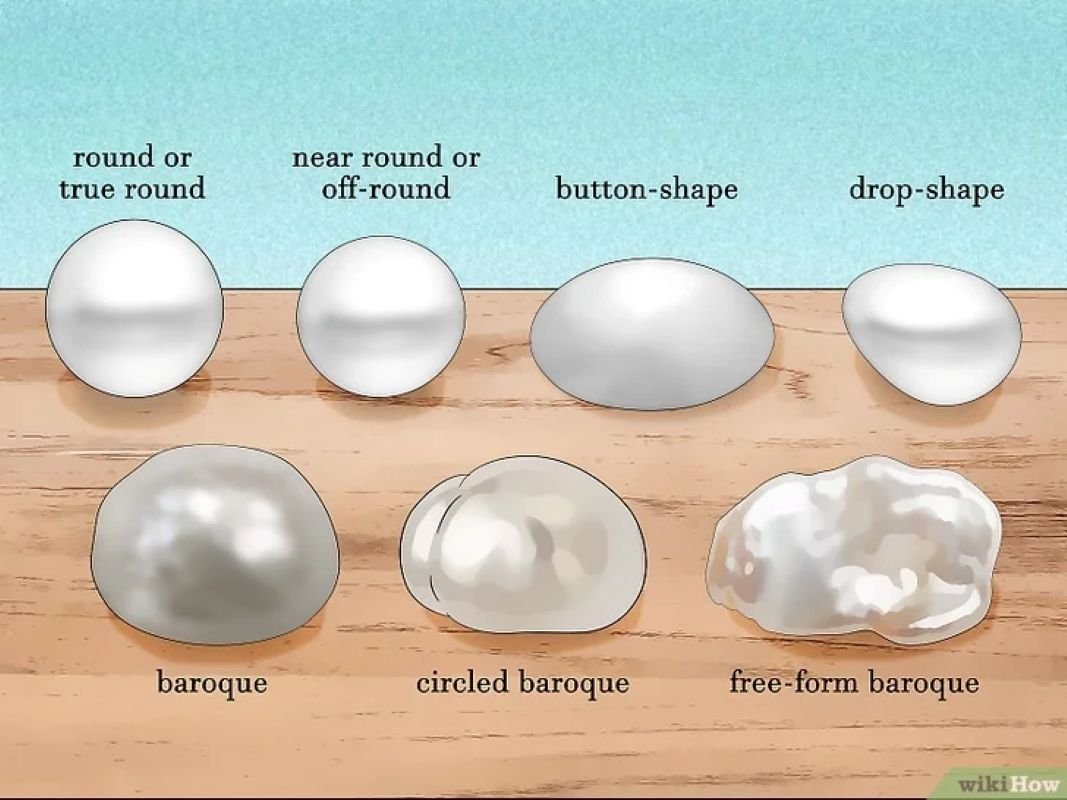
This group includes round, near-round, button, and drop. Each side mirrors the other to a noticeable degree. Symmetry supports matching, especially in strands and earrings.
Semi-baroque shapes
These pearls show some symmetry but with an evident irregularity. Ovals, pears, and drops with slight axis shifts fit here. The silhouette is orderly, yet not geometric.
Baroque and free-form
Baroque pearls are irregular with curves, folds, or lobes. Free-form baroques push that further, often sculptural. Circled baroque pearls show one or more concentric rings caused by growth disruptions. These forms suit artistic, modern, or organic designs.
Shape Profiles
Round
Round pearls are spherical within tight tolerances. They reflect light evenly and look balanced from any angle. Akoya farms prize them, but round South Sea and Tahitian pearls are highly sought because of their size.
Pricing reflects rarity. High luster, clean surface, and fine matching can nudge round strands into investment territory. Reference: Pure Pearls: Shapes Guide.
Near-round and off-round
Near-round pearls appear round to the casual viewer but reveal slight axis differences under inspection. Off-round shows a more obvious deviation. These categories offer a sweet spot: the round look without round pricing.
In strands, near-round pearls perform beautifully. The shape variations are subtle on the neckline.
Button
Button pearls are flattened on one side and domed on the other. They sit close to the ear or wrist and present a broad face of luster. Freshwater producers commonly supply buttons in many sizes and colors.
Cost efficiency is strong. Many buyers prefer button studs for daily wear because they don’t protrude.
Drop
Drop pearls taper from a wider base to a narrower top. Think teardrop. They’re ideal for pendants and earrings, creating elegant vertical lines that elongate the neck.
Fine drops with smooth, uninterrupted contours and strong luster can reach premium prices, particularly in South Sea and Tahitian categories.
Baroque
Baroque pearls are irregular with bulges or folds. They catch light unpredictably, which can magnify luster and orient. Large baroque South Sea and Tahitian pearls often exhibit gorgeous overtones.
Designers love them. Each pearl feels individual.
Circled baroque
Circled pearls have one or more rings running around the body. The circles come from periodic growth disturbances. Although the texture is visible, the effect can be striking, especially with peacock-tone Tahitian colors.
Pricing is typically below smooth baroques, yet appeal is strong for those who like distinct character.
Free-form baroque
These pearls are sculptural and unconstrained. Lobed, elongated, or asymmetric, they become the focal point of a piece. Large free-forms are excellent for statement necklaces and art jewelry.
They are conversation pieces.
Keshi
Keshi pearls form without a solid nucleus. They are almost all nacre, often small to medium in size, with sharp luster and interesting shapes ranging from seed-like to leaf-like. Keshi can result from rejected beads or from tissue-nucleation byproducts.
Because they contain no bead, keshi are valued for nacre purity and sparkle. Definitions vary by region; for background, the industry’s terminology framework appears in CIBJO’s Blue Books: CIBJO Blue Books.
How Shape Influences Value?
What buyers pay premiums for?
– Round pearls with strong luster and clean surfaces
– Matched drops with smooth symmetry and minimal blemishes
– Matched buttons for studs with bright faces and neat profiles
– Large sizes in symmetrical shapes, especially South Sea and Tahitian
Top matches in strands and pairs boost value significantly. Consistency is hard work for graders.
When irregular shapes command attention?
Uniqueness sells. A baroque with mesmerizing orient and thick nacre can outshine a dull round pearl. Distinctive circled patterns in rich colors also draw collectors, particularly if price-per-millimeter is favorable.
Large, well-formed baroques give budget access to dramatic looks. Designers can get significant visual impact without round premiums.
Shape and Jewelry Choices
Best shapes for necklaces and strands
– Round and near-round: classic uniformity, ideal for formal wear
– Off-round: value-friendly while keeping the round appearance
– Baroque and circled baroque: bold, artistic strands with varied reflections
– Free-form: statement pieces featuring standout center pearls
Graduated strands benefit from symmetrical shapes for a smooth visual taper. Baroque strands prioritize character over strict uniformity.
Best shapes for earrings and pendants
– Button studs: comfortable, flat back, broad luster face
– Round studs: timeless choice with strong resale appeal
– Drops: elegant movement for dangles and pendants
– Baroque and keshi: unique silhouettes that spotlight texture and orient
Pairing matters for earrings. Aim for mirrored shapes, not identical twins, unless buying top-grade matches.
How to Spot Shape Differences at Home?
Spin test and roll test
Use a clean, flat surface. For round pearls, the spin or roll should be smooth and consistent. A wobble suggests near-round or off-round. With drops and buttons, the asymmetry will interrupt a straight roll.
Go gently to avoid scratches.
Visual checks and simple tools
– Compare profiles at eye level from several angles
– Use millimeter paper or a ruler to spot diameter differences
– Try smartphone macro mode or a loupe for contour inspection
– Place two pearls side-by-side and rotate both to judge symmetry
Consistent lighting helps. Natural daylight reveals contours and luster without harsh glare.
Frequently Asked Questions on Pearl Shape
Are near-round pearls a good value?
Yes. They give the visual impression of round pearls at a lower price point. In a strand, minor deviations are hard to detect once worn, especially under ambient light.
What is a keshi pearl?
It is a non-bead-nucleated pearl, usually formed as a byproduct in cultured pearl farming. Keshi are composed almost entirely of nacre, which explains their lively luster and irregular shapes.
Do circled pearls indicate poor quality?
Not necessarily. Circles are a growth characteristic, not a defect by default. Value depends on luster, color, and overall appeal. Many buyers prize circled Tahitians for their rings and peacock tones.
Do shapes differ by pearl type?
Yes. Akoya commonly skews round to near-round in smaller sizes. South Sea and Tahitian offer more drops and baroques at larger sizes. Freshwater pearls, being tissue-nucleated, present a broad spectrum from button to wild baroque, including many near-rounds today due to advanced culturing.
For a helpful reference that summarizes differences across types and shapes, see GIA’s primer: GIA: Pearl Information.
Smart Buying Tips for Your First Strand
Set priorities on luster surface and shape
Decide what you value most. If a glowing face is your goal, choose the highest luster you can afford, then target shape. For a classic look, round or near-round. For individuality, baroque or circled baroque. Keep surface quality in the mix; fewer blemishes improve long-term satisfaction.
Write your top two priorities before shopping. That keeps choices focused.
Pick the right pearl type for your budget
– Freshwater: good entry point, strong selection of near-round, button, and baroque; excellent value
– Akoya: bright luster and refined look, often in round to near-round; sizes generally up to about 9–9.5 mm
– Tahitian: naturally dark tones, large sizes, many drops and baroques; dramatic presence
– South Sea: large and luxurious, white or golden; round and drop shapes carry premiums
Balance size and shape. A slightly smaller, rounder pearl can cost less than a larger round of the same type.
Work with reputable sellers and certifications
Choose vendors who disclose origin, type, size, shape category, surface grade, and luster expectations. Clear photography from multiple angles helps you judge shape at home.
Independent education resources support smarter choices. Two useful starting points:
– Pure Pearls: Pearl Shapes Guide
Some labs issue reports for specific pearls. Standards vary by region, so ask sellers what documentation is available and what it covers.
Finally, trust your eyes. If a strand’s shape and luster make you smile in normal room light, you’re close to the right choice.