An Enduring Circle of Myth and Majesty
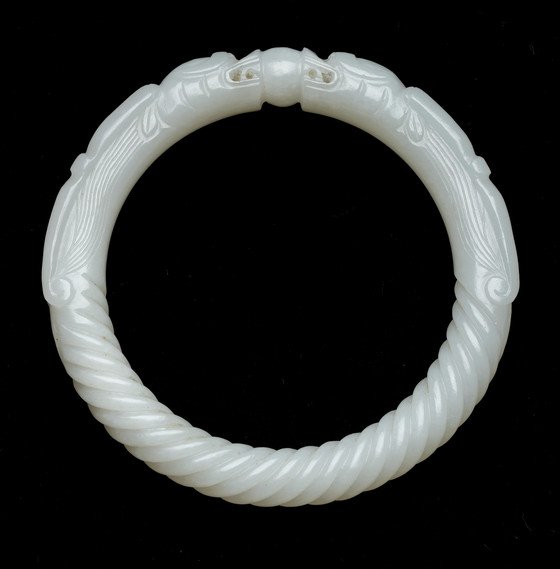
It rests in stillness, a perfect circle of pale, luminous green stone. Cool to the eye, it suggests a coolness to the touch, a weight of centuries held in its polished form. This is not simply an ornament. It is a world unto itself, a miniature sculpture meant for a human wrist, where imperial beasts are frozen in an eternal, silent chase. Carved from a single piece of jade during the height of China’s Qing dynasty, this bracelet is a concentration of belief, artistry, and power. It speaks of a time when mythology was woven into the very fabric of daily life and the materials of the earth were thought to hold a connection to the heavens.
Its form is simple. A circlet.
Yet, within that simplicity, a universe of meaning unfolds. Two dragons, the most potent symbols of celestial authority, writhe across its surface. Their destination, their singular focus, is a single, perfect pearl, a sphere representing wisdom and cosmic truth. The object’s journey from a Qing courtier’s possession to a modern museum display is a story of survival, a testament to the enduring allure of masterful craftsmanship and the potent narratives embedded in stone. It is a quiet object that roars with history.
The Artistry of Heavenly Stone
To look closely at the bracelet is to appreciate an artistry that required immense patience and a profound understanding of the material. The jade itself is not merely a medium; it is a participant in the story. Its subtle tones, ranging from a soft celadon to a milky white, give the creatures it depicts an ethereal, otherworldly quality. They seem to emerge from a celestial mist, their forms defined by the skilled hand that knew exactly how to reveal the stone’s inner light.
A Dance of Two Dragons
The dragons are not static. Their bodies coil and uncoil, creating a powerful sense of motion around the bracelet’s circumference. One can almost feel the tension in their sinuous forms. Finely incised lines delineate their scales, each one a tiny, perfect crescent. Their manes flow back as if in a celestial wind, and their heads, with flared nostrils and focused eyes, are studies in controlled ferocity. They are not monsters of destruction but guardians of divine order.
They are caught in a perpetual pursuit, a balanced, symmetrical dance of power. Their limbs are taut, their claws sharp, yet their movement is one of grace rather than aggression. They are two halves of a whole, a representation of cosmic balance, forever circling, forever reaching. The artist has captured a moment of supreme energy and contained it within the confines of this small, wearable object.
The Luminous Pearl of Wisdom
Positioned between the two advancing dragons is the prize: the flaming pearl. It is the focal point of the entire composition, the object of their unceasing quest. Polished to a soft gleam, it appears to glow with its own internal light. This is not just a bead; it is the pearl of wisdom, a potent symbol in Taoist and Buddhist traditions representing truth, enlightenment, and spiritual purity. Its presence elevates the scene from a mere depiction of mythical beasts to a profound allegory for the search for knowledge and perfection.
The “flames” that lick at its edges are carved with delicate precision, suggesting a powerful energy radiating from within. This single sphere transforms the dragons’ chase into a noble quest, a physical manifestation of a spiritual journey.
Crafted by a Master’s Hand
The creation of such an object was an act of immense dedication. Jade, a stone prized for its toughness, cannot be carved with a knife in the way one might shape wood or softer stone. It must be abraded, patiently ground away with grits of harder minerals, such as sand or crushed jewels. The process is slow, laborious, and unforgiving. A single slip could ruin months, or even years, of painstaking work.
Imagine the artisan in an imperial workshop, hunched over his bench. The air is thick with the fine dust of jade and abrasive sand. With small saws, drills, and grinding wheels, powered by a foot-treadle, he slowly coaxes these forms from the solid block of stone. The process is one of reduction and refinement, of slowly revealing the spirit within the material. The final polish, using fine sand and leather, would have brought out the stone’s characteristic soft luster, a glow that seems to emanate from deep within. The result is an object that feels as good as it looks, smooth and substantial in the hand.
Whispers of Power and Purity
The bracelet’s meaning extends far beyond its physical beauty. For its original owner, it was a potent collection of symbols, a wearable piece of cosmology that reinforced their place in the universe. Each element—the material, the creatures, the composition—was saturated with centuries of cultural and spiritual significance. To wear it was to drape oneself in the language of authority and divine favor.
The Imperial Dragon’s Embrace
In imperial China, the dragon was the ultimate emblem of the emperor’s power. As the Son of Heaven, the emperor was considered the intermediary between the celestial realm and the earth, and the dragon was his personal symbol. This celestial creature was believed to control the elements, particularly water and rain, ensuring bountiful harvests and the prosperity of the empire.
To have these creatures wrapped around one’s wrist was a direct and personal connection to that immense imperial power. While the five-clawed dragon was strictly reserved for the emperor himself, other variations were used by nobility and high-ranking officials. The presence of two dragons doubles this symbolic potency, creating a shield of spiritual and temporal authority around the wearer. It was a statement of proximity to the throne, a sign of immense prestige.
Jade: The Stone of Heaven’s Favor
Jade, or ‘yu’ (玉), has held a sacred place in Chinese culture for over nine thousand years. It was considered the “Stone of Heaven,” a material that embodied the virtues of purity, goodness, and intelligence. The philosopher Confucius likened its properties to the virtues of a gentleman: its smoothness to benevolence, its hardness to integrity, and its translucence to sincerity.
It was also believed to possess protective qualities, warding off evil spirits and preserving the body after death. For the living, it was thought to bring good health and fortune. A bracelet made of pure jade was therefore more than an adornment. It was an amulet, a source of spiritual comfort and a constant reminder of the virtues one should aspire to possess. The stone’s cool, smooth touch against the skin would have been a continuous physical connection to these powerful ideas.
An Echo from the Opulent Qing Court
This bracelet was born into a world of incredible wealth, strict protocol, and refined aesthetic taste. The middle Qing dynasty, spanning the 18th century, was a period of stability and prosperity under powerful emperors. The imperial court in the Forbidden City was the center of this world, a place where art was not just for appreciation but was an essential tool for communicating status and maintaining order.
Jewelry as Status and Story
In the Qing court, every detail of one’s dress and adornment was prescribed by intricate regulations. The materials one could wear, the colors, and the motifs all communicated rank, lineage, and occasion with immediate clarity. A piece of jewelry like this jade bracelet was not a casual choice. It was part of a carefully constructed identity.
Its wearer was undoubtedly a person of high standing, most likely a woman of the imperial household—an empress, a consort, or a princess. For her, this bracelet was a part of a larger story told by her magnificent silk robes, her elaborate hairstyle pinned with gold and kingfisher feathers, and other jade and pearl adornments. It signified her connection to the imperial dragon and her place within the protected, opulent walls of the court.
The Flourishing of Imperial Workshops
Such a masterpiece could only have been produced in the imperial workshops established by the Qing court. These institutions brought together the most talented artisans from across the empire, giving them access to the finest and rarest materials. Jade boulders, carefully selected and transported over vast distances, were delivered to these workshops to be transformed by masters of the craft.
The standards were exacting. Each piece had to be technically flawless and aesthetically perfect, fit for the discerning eye of the emperor or his family. This environment of intense patronage and high expectations pushed craftsmanship to extraordinary heights. This bracelet is a surviving artifact from that golden age of Chinese decorative arts, a testament to the skill and resources concentrated within the imperial palace.
A Timeless Treasure’s Journey West
The world in which this bracelet was created has long since vanished. The Qing dynasty fell, the Forbidden City was opened, and its treasures were slowly scattered. The journey of this particular piece from the inner chambers of an imperial palace to a public collection in Los Angeles is a silent story of survival. It passed through the turmoil of revolutions and the hands of dealers and collectors, its intrinsic beauty and significance preserving it through the tides of history.
From an Empress’s Chambers to a Collector’s Care
One can imagine the bracelet on the slender wrist of a Manchu noblewoman, its cool jade a contrast to the warm silk of her sleeve. It would have caught the filtered light of a palace chamber, its dragons glinting softly. It was a personal item, part of an intimate world of courtly life.
With the passage of time, it left that world behind. Perhaps it was sold during the turbulent years of the early 20th century or carried out of China by a family fleeing conflict. It eventually entered the Western art market, its identity transformed from a personal adornment and symbol of status into a historical artifact and a work of art. It found a new kind of appreciation in the hands of a collector, Patricia G. Cohan, who recognized its exceptional quality before it was finally gifted to a public institution, ensuring its preservation for future generations.
The Undiminished Glow of a Masterpiece
Today, the bracelet rests in a climate-controlled case, spot-lit and admired by thousands. It no longer adorns a wrist or signifies courtly rank. Its function has changed, yet its essence remains. The power of the dragons is undiminished, their chase just as dynamic as it was three hundred years ago. The pearl continues to offer its silent promise of wisdom, and the jade glows with the same soft light that captivated an emperor’s court.
It has outlived its creators and its original owners. It has outlasted the dynasty that produced it. The object serves as a tangible link to a sophisticated civilization, carrying the weight of its myths, the refinement of its aesthetics, and the touch of a master’s hand. The circle is unbroken, the dragons’ dance is eternal, and the stone from heaven continues to whisper its majestic story.