
Power Tucked Into A Shimmer Of Paint
I’ve never trusted a pearl in a painting to be just a pearl. That milky oval, that cool flash perched on a lobe or falling in ropes across a bodice, always carries more weight than it seems. Even before you read the sitter’s name, the jewelry starts talking. Sometimes it’s bragging. Sometimes it’s praying. Sometimes it’s bait.
Oil painters learned early that a pearl is a small theater: a tight, reflective world where a room, a window, a person, and a painter’s hand can collapse into one bright dot. That dot is not merely decorative. It’s a thesis in miniature about the person wearing it and the culture that made it valuable.
So yes, pearls are everywhere in classical painting. And no, that ubiquity isn’t neutral. It’s strategy.
They are props with power.
How To Read Pearls As Visual Rhetoric
Wealth and social rank
Let’s be plain: pearls were expensive. Naturally formed pearls required years inside oysters, dangerous diving, and long-distance trade. To hang them from your ears or drape them by the yard across your torso was to announce your place in the pecking order without saying a word.
In portraits of monarchs and merchants alike, a pearl or a whole strand functions like a notarized document. The sitter is solvent. The family is powerful. The lineage has assets. If gold shouts breadth, pearls purr depth—old money, old networks, old privilege. That’s why the beads often appear in multiples, studding sleeves and headdresses, swarming brooches, multiplying like capital in an account book.
They are receipts for status.
Purity, Virtue, and Propaganda
The pearl’s biology—born from irritation, sealed in nacre—fed allegories of incorruptible virtue. In Christian settings, it could stand for Mary’s chastity, a sealed drop of perfection. In secular court culture, the same association was drafted into image-making strategy. When purity becomes policy, the pearl becomes propaganda.
For a queen, this was useful. A monarch who needed to assert moral authority would thread that message right onto the body. The bead then becomes a halo you can clasp. The result is less jewelry than ideology stitched in light.
Perfection, but portable.
Desire, Vanity, and the Gaze
Pearls also perform a more intimate task: they tempt the eye to linger where social rules already concentrate attention—ears, neck, breastbone. Painters know this. They place a bright highlight at the tip of a lobe, or at the soft dip of the collarbone, inviting a viewer to look, then look again. The pearl isn’t just a circle of light; it’s a leash for the gaze.
This is not neutral. It can be tender, as with a single drop on a young woman’s ear catching daylight. It can also slide into calculated allure, making the body legible as ornament, as display, as commodity. The pearl reflects the room—and the viewer’s appetite—right back at them.
Glamour is seldom innocent.
Portraits That Turn Ornament Into Argument
Vermeer and the intimacy of a single gleam
Vermeer’s Girl with a Pearl Earring is the canonical example because it strips the pearl down to its essence: one swollen drop, one pinpoint of white, a quiet storm of blue and ocher around it. To my eye, the earring is not just an accessory; it’s the hinge on which the entire painting swings. The face turns, the eyes meet yours, and the tiny light becomes the painting’s heartbeat. Without that glint, the painting would still be beautiful. With it, the painting talks.
The earring also complicates class. It suggests access to luxury while the headscarf and the plainness hint at theatrical costume rather than real-world wealth. This is less an inventory of possessions than a fantasy of presence. The pearl becomes a trick: it convinces you that fleeting attention can crystallize into intimacy.
That whisper of light is a contract between seer and seen.
Elizabeth I And The Armor Of Image
Step into Tudor portraiture and the pearls multiply like edicts. In the Darnley portrait of Queen Elizabeth I, they parade across the costume, frame the face, and punctuate the power pose. They are not soft here. They are hard facts. If Vermeer’s pearl invites you closer, Elizabeth’s pearls keep you at the correct distance.
I read them as strategic armor—conspicuous virtue threaded through conspicuous wealth. The queen’s unmarried status demanded an iconography that could police desire and make chastity look imperial rather than restrictive. Pearls do that work perfectly. They are polished modesty turned into spectacle, a theology of rule worn as jewelry.
Sanctity, weaponized.
Cleopatra And The Theater Of Expense
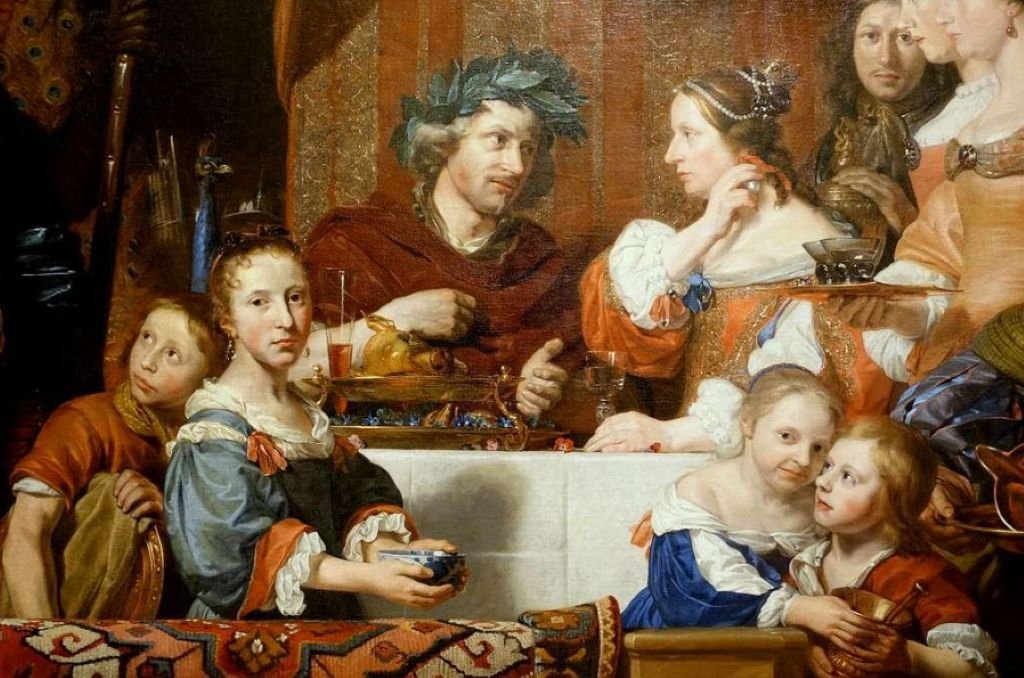 The banquet of Cleopatra dissolving a pearl in vinegar—painted by Jan de Bray in 1669—belongs to a long tradition of images staging the ultimate flex: consuming wealth to prove you have more. Whether the ancient story holds water is almost beside the point. The painting, like the anecdote, treats the pearl as an accelerant for myth. It’s not adornment; it’s currency set on fire in front of an audience.
In de Bray’s hands, the scene becomes a meditation on theatrical power. Cleopatra doesn’t wear her pearl; she annihilates it to win a contest of prestige. That gesture has always struck me as a critique wrapped in a spectacle. The image is titillation and warning. Showy expenditure can crown you or doom you. Either way, the pearl is the perfect prop for the lesson.
Luxury as dare.
Paxton And The Modern Shimmer
Jump forward to William McGregor Paxton’s String of Pearls (1908), and the mood shifts. The beadwork still signals wealth, but the setting breathes bourgeois comfort rather than royal command. Paxton’s soft edges and controlled highlights transform the pearls into a meditation on leisure, consumption, and taste within a modern interior. The painted shine is gentler, more private, yet no less calculating.
To me, Paxton captures the new century’s quiet concession: aspiration can be domestic. The string, coiled in a lap or slipping through fingers, becomes a ritual object for self-fashioning in a consumer age. It’s less about public authority and more about personal allure, the kind of power that works across dinner tables and parlors rather than thrones.
Soft power, softly lit.
The Hidden Economies Behind The Shine
Empire, trade, and extraction
Every painted pearl carries the echo of where it came from. Before cultured pearls, natural ones were pulled from oysters in waters off the Persian Gulf, the Indian Ocean, and parts of the Caribbean. That labor was dangerous and often coerced. Trade routes ferried tiny spheres across vast distances into European markets, where they were priced, sorted, and resold to those who could turn them into status.
So when I see a lavish collar of pearls, I also see a world system ticking beneath the fabric: divers risking lungs, brokers counting margins, empires tightening their grip on coasts and harbors. The bead may be small, but the chain that delivers it is long and often brutal. Paintings rarely show that chain.
The shine hides a scaffold.
Gender, Labor, And The Unseen Hands
There’s also the quiet labor that never makes it onto the canvas. Someone strung those pearls. Someone cleaned them, stitched them into gowns, fastened them before a sitting, unfastened them after. Domestic workers and artisans—many of them women—kept the machinery of display humming while remaining invisible in the finished picture.
Even within studios, assistants prepared canvases, mixed paint, and sometimes executed passages that the master would later unify. A single glossy dot on a pearl might be the master’s flourish, but it rides on layers of collective work. The painting celebrates the person who can afford the pearls. It rarely credits the hands that made such display possible.
Visibility is rationed in art, too.
What the old glitter asks of the modern eye
So what do I think we should do with all this shimmering evidence? First, look harder. A pearl in a portrait is an invitation to read image-making as politics writ small. If the sitter is advertising wealth, ask whose resources made that wealth concrete. If the sitter is claiming virtue, ask who must believe it for the claim to work. If the sitter is radiating allure, ask who is meant to be persuaded.
Second, allow some ambiguity to stand. Vermeer’s single gleam isn’t just consumer signaling; it’s also an exquisite visual problem solved with grace. The pleasure of that solution matters. Beauty is not a bribe you must refuse to stay ethical. It’s a door you can walk through with your eyes open.
Finally, connect the dots to our own image economy. We still use jewelry to signal story: engagement rings in selfies, luxury watches peeking from cuffs, pearls rebranded for boardrooms. The codes have shifted, but the basic grammar holds. Tiny objects, huge claims.
The mirror has not retired.
A Closing Case For Why These Pearls Still Matter
I keep returning to pearls in old oil paintings for one reason: they compress power into a dot of light you can’t ignore. Vermeer turns that dot into intimacy. Elizabeth I turns it into statecraft. Cleopatra turns it into expenditure-as-spectacle. Paxton turns it into modern comfort and taste. Each painting makes jewelry behave like language.
And those languages continue to speak. They reach across centuries to instruct, seduce, and challenge. They warn us that wealth loves to dress as virtue, that virtue enjoys appearing as luxury, and that desire happily translates both into gaze. Pearls expose those swaps by shining at the exact point where body meets symbol.
So the next time you spot them—on a canvas or in a shop window—pause. Let that small sphere remind you of its long history of work and wish-making, its use as bait and badge, its ability to make a face look like fate. Then decide what you’re being asked to believe.
I’ll admit it: I still fall for the gleam. But I try to count the cost behind it. The paintings helped teach me how.