A New Chapter for Pearls in 2026
From Ceremonial to Everyday
The old equation—pearls equal formality—no longer holds. By 2026, adoption patterns show pearls moving from event wear to weekday rotation, driven by a broader casualization of dress and the blending of work and leisure wardrobes. That shift lowers the perceived “risk” of wearing pearls with denim, knits, and tech fabrics, expanding use cases without diluting their cachet.
The design response has been pragmatic. Shorter strands and micro-studs sit comfortably alongside minimal hoops. Silhouettes avoid fuss and prioritize clean geometry, which pairs well with contemporary ready-to-wear. In practice, this means pearls now function as a textural neutral—soft luster that anchors sharper lines.
The result: higher frequency of wear. And higher frequency often translates into stronger category sales.
Drivers of the Shift Culture: Runway and Social
Cultural signals matter. Music and sports figures wearing pearls on talk shows, red carpets, and street style feeds have reframed them as confident rather than delicate. Runway styling has reinforced that framing—think chunky links interspersed with pearls or suiting punctuated by a single iridescent stud. For reference, recent show imagery indexed on Vogue Runway provides a clear record of these choices across seasons and houses: Vogue Runway.
Social media completes the loop. Short-form videos often show quick swaps: chain-only stack, then chain-plus-pearls; suit-only, then suit-plus-pearls. That immediate contrast teaches styling rules in seconds. The shareability accelerates normalization, turning pearls into an everyday proposition rather than a special-occasion indulgence.
Layering and Mixed Materials Reshape Styling
Neck Stacks That Balance Texture Weight and Shine
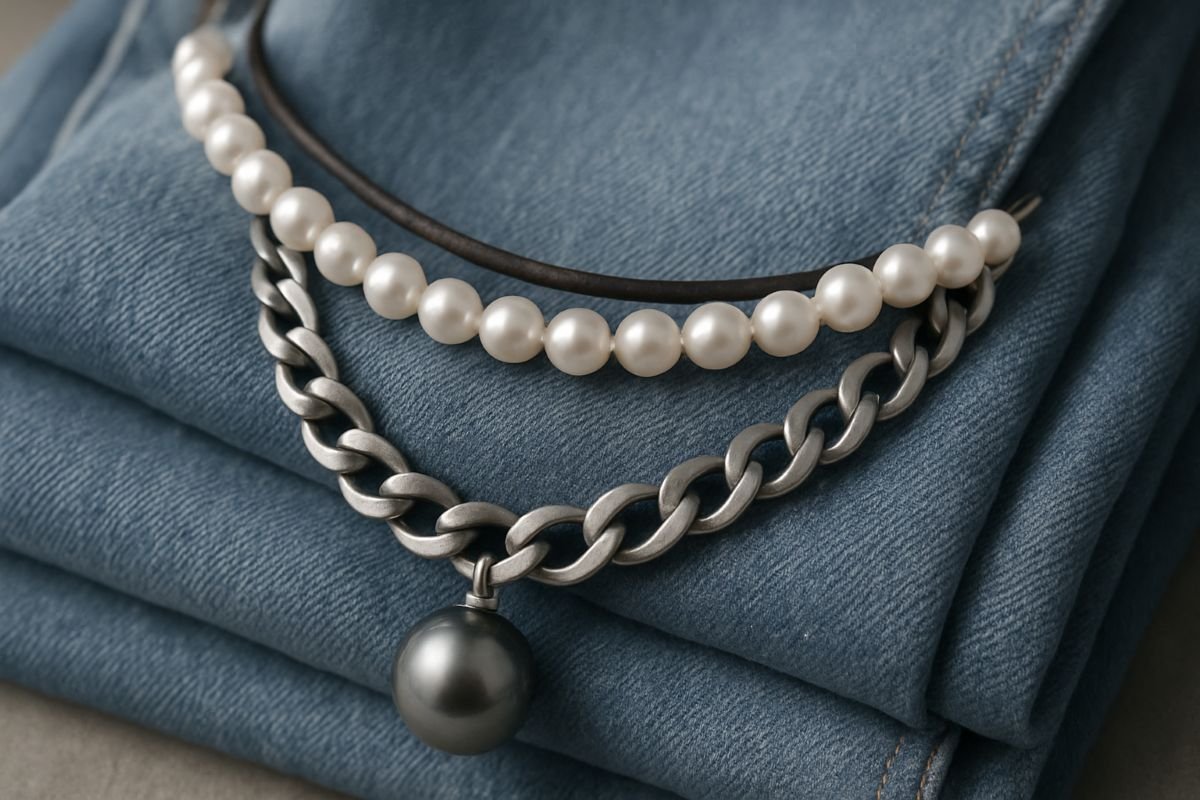
The most persuasive stacks now consider three variables: texture, mass, and reflectivity. Pearls contribute a low-gloss glow, chains add directional shine, and cords or leather bring matte contrast. Balance comes from alternating those properties across lengths—choker, mid, and pendant distances—so weight doesn’t pool at the sternum.
Practicality still counts. Pearls are organic gems with nacre that can scratch. Positioning a pearl strand slightly above heavier links reduces abrasion. A spacer bead or a soft cord layer between metal and nacre also helps. These tweaks protect luster without compromising the look.
Short note: symmetry is optional. Intent is not.
Earrings Go: Oversized Geometric and Artful Mismatch
Silhouettes are expanding. Large domed studs, elongated drops, and angular settings stack visual weight under the lobe, creating a strong vertical line. Designers are also pairing a single statement earring with a minimal counterpart, amplifying asymmetry. The point is not provocation; it’s composition. The ear becomes a small stage for proportion and negative space.
Comfort plays a role. Oversized pieces should use lighter materials in the structure and a secure back. Buyers are evaluating grams and engineering alongside aesthetics, a shift from pure ornament toward product performance.
Color and Silhouette Innovation Expands the Palette
Tahitian Depth and Freshwater Pastels
Color is widening the conversation. Dark bodycolor Tahitian pearls introduce stormy greens, peacocks, and gunmetal tones that align well with blackened metals and graphite textiles. At the other end, freshwater pastels—lavender, blush, and peach—soften monochrome outfits and lighten heavier leathers and wool.
For consumers comparing options, GIA’s educational pages clarify how bodycolor, overtone, luster, and surface quality interact across pearl types: GIA: About Pearls. This knowledge reduces buyer hesitation and supports premium positioning where warranted.
Baroque and Sculptural Forms As Personal Signatures
Baroque pearls shift the value narrative from “matching perfection” to “individual character.” Irregular silhouettes catch light unpredictably, increasing visual interest at smaller sizes. They also compress cost-per-impact: a unique baroque drop can outshine a larger, standard round where budgets are finite.
Sculptural settings—negative space hoops, knife-edge bezels, biomorphic caps—frame each pearl as a singular object rather than a unit in a set. That frames personal identity, not conformity. In a crowded accessories market, this differentiation has commercial weight.
Gender Inclusive Adoption and Cross Category Styling
Unisex and Menswear Design Cues
Pearls integrated into curb chains, ID tags, and minimal chokers have reset cues historically coded as “feminine.” The aesthetic logic is straightforward: a soft sphere juxtaposed with industrial links sharpens both elements. The look sits cleanly with tailoring, varsity casual, and streetwear.
Brands serving broader audiences have leveraged simple formats—single pearl pendants, short strands with robust clasps, or studs sized at 7–9 mm—to reduce decision friction. For accessible references, see contemporary lines such as Miansai and Mejuri, which publish unisex edits: Miansai, Mejuri.
Pearls Beyond Jewelry: Apparel, Bags, and Footwear
Embellishment is now a cross-category motif. Beads at seams, detachable pearl charms on handbags, and pearl-tipped laces introduce luster without the commitment of fine jewelry. Houses like Simone Rocha have long demonstrated how pearls can structure a garment’s attitude: Simone Rocha.
Durability must be considered. Friction from straps or cuffs can abrade nacre; placement near high-wear zones reduces product life. Smart brands specify reinforcement and offer replacement options, turning maintenance into a service touchpoint.
Sustainability and Ethics Strengthen the Value Proposition
Cultured Pearls and Environmental Considerations
Pearl cultivation depends on clean water and healthy mollusks. That dependency turns environmental quality from a marketing claim into an operational requirement. Research collated by the Sustainable Pearls project details how farm practices influence ecosystems and rural livelihoods: Sustainable Pearls.
Bivalves filter water, which can support local clarity and biodiversity when farms manage density and waste responsibly. For broader context on bivalve ecosystem services, The Nature Conservancy’s work on oyster reefs is instructive, even though food and gem aquaculture differ: The Nature Conservancy. The takeaway is clear: environmental stewardship and product quality are intertwined in this category.
Traceability, Certifications and Responsible Sourcing
Formalized standards help buyers separate signal from noise. The Responsible Jewellery Council’s Code of Practices sets expectations for business ethics, human rights, and environmental performance across jewelry supply chains: RJC Code of Practices. While pearls occupy a niche within broader precious materials, alignment with recognized frameworks increases trust.
Technical nomenclature also matters. CIBJO’s Pearl Blue Book outlines terminology, treatment disclosure, and grading guidance that protect consumer understanding: CIBJO Blue Books. For product-level clarity, GIA offers pearl identification and care information that retailers can integrate into client education: GIA Pearl Quality Factors.
Building a Modern Pearl Capsule
Core Pieces: Studs, Strands and Statement Accents
A compact yet versatile set might include:
– 6–7 mm studs for daily wear
– A 14–16 inch strand with uniform freshwater pearls
– A single baroque pendant on a fine chain
– One high-impact piece—oversized drop earrings or a mixed-link-and-pearl necklace
Each item covers different styling needs—subtle presence, streamlined polish, focal interest, and dramatic punctuation. Together, they unlock most outfits, from knit polos to evening slips.
Mixing Metals, Silver, Gold and Leather Without Clash
Consistency of temperature and finish prevents visual noise. Cool pastels and Tahitian tones read clean with silver or rhodium; warmer creams and goldens sit well with yellow or bronze hues. Leather cords stabilize stacks by adding matte contrast and reducing metal-on-nacre contact.
A structural rule helps: pearls nearest the skin, metals outermost. That preserves luster and keeps edges away from nacre. Simple and effective.
Care, Storage and Maintenance for Longevity
Pearls should be the last piece on and the first piece off. Wipe with a soft cloth after wear, avoid contact with fragrances or hair sprays, and store in a fabric-lined pouch to prevent scratching. Strands benefit from periodic restringing—annually for frequent wear, less often otherwise. Detailed guidance is available from GIA: GIA: Pearl Care.
Humidity matters. Extreme dryness can cause nacre to lose luster over time. A simple, breathable storage setup prevents most issues.
Outlook for 2026: Market and Brand Directions
Pricing Tiers: Investment Logic and Resale
Price stratification in pearls remains rational and transparent to educated buyers:
– Freshwater: broad size range, improved luster due to farming advances, accessible entry pricing
– Akoya: high luster and roundness at moderate sizes, premium for matched strands
– Tahitian: larger sizes and darker bodycolors, premiums for rare overtones
– South Sea: thick nacre, substantial sizes, higher pricing for top luster and clean surfaces
Drivers include size, luster, surface quality, shape, and matching—weighted differently per product type. Branding and provenance add a second layer of value. On resale, condition and brand equity lead outcomes; platforms like The RealReal provide market signals and transparency on pricing trends: The RealReal.
For buyers thinking long term, spending on luster and surface quality tends to hold better than chasing marginal size increases that strain budgets.
Designers and Houses to Watch in 2026
Heritage and contemporary voices are shaping the category from different angles:
– Mikimoto continues to push technical perfection and high-jewelry theatrics, a benchmark for classicists: Mikimoto.
– Sophie Bille Brahe’s sculptural freshwater compositions show how minimalism and romance can coexist: Sophie Bille Brahe.
– Completedworks leans into baroque forms with architectural settings, influencing everyday statement wear: Completedworks.
– Ready-to-wear leaders—Prada, JW Anderson, Simone Rocha—continue to use pearls as structural styling tools across apparel and accessories. Their runway outputs, archived on Vogue Runway, influence retail buys and diffusion lines downstream: Vogue Runway.
A final note on momentum. The category’s growth is not about nostalgia; it’s about re-specifying luster, form, and color for modern wardrobes and mixed-gender audiences. As long as design keeps solving real styling problems—day-to-night transitions, texture balance, durability—pearls will keep gaining closet share.
The edge now belongs to luster used intelligently. And to pieces that earn repeat wear.