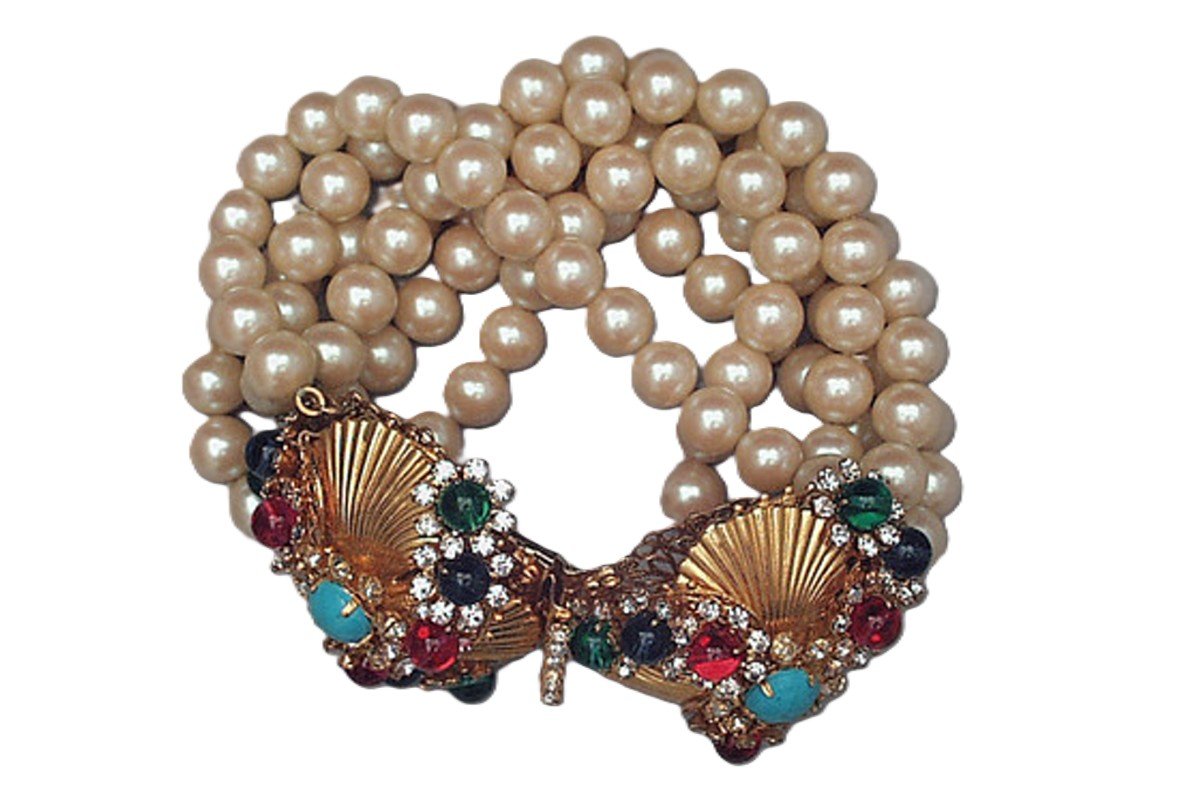
 A 1971 Shimmer in the Hand:Introduction to a Bracelet by William De Lillo
The year is 1971, and a slim cuff glows like a small aurora against the skin. That glow—part glass, part gilded metal—belongs to a woman’s bracelet designed by William de Lillo, measured at 8 by 2 inches and built for theater at the wrist. It does not whisper. It glints.
The bracelet lives in the Costume and Textiles collection at the Los Angeles County Museum of Art (LACMA), accession number M.87.251.2j, gifted by de Lillo and his longtime collaborator Robert F. Clark. At a glance, it radiates light; up close, it reveals the practiced hand behind every stone and bead.
Austrian glass beads, simulated gems, and faux pearls sit in concert across gold-electroplated brass. The materials tell the story: beauty without preciousness, technique without pretense.
It glitters softly.
Meeting the Maker William De Lillo
From Belgium to New York
William de Lillo was born in Belgium in 1925 and later established his practice in the United States, building a name in fashion jewelry that favored wit, glamour, and expert construction. His work found its footing in New York’s creative circuits, bridging European sensibility with American appetite for bold, confident accessories.
He worked for decades. He refined the language of costume jewelry without apology.
The bracelet at LACMA reflects that journey: Continental polish, American scale.
A Partnership Shaped by Collaboration
De Lillo’s collaboration with Robert F. Clark shaped the arc of his career. Clark brought a designer’s eye for movement, while de Lillo’s command of materials kept each idea grounded. Together they built pieces that moved with bodies and wardrobes, not against them. Their gift of the bracelet to LACMA makes the partnership part of the public record and places their work within a broader conversation about twentieth-century fashion and craft.
A duo’s signature, set in metal and glass.
The World This Bracelet Entered:1970s Fashion and Costume Jewelry
The early 1970s were exuberant. Evenings spun under disco lights; daytime leaned into fluid silhouettes, trousers, and long skirts. Jewelry kept pace. It grew larger, brighter, more theatrical—confidence translated into scale. Designers played with glass, resin, and base metals, testing the boundary between runway flourish and streetwear sparkle.
Costume jewelry, already a force since the mid-twentieth century, became a stage for personality. A bracelet like this one could sit beside a silk blouse or a sharply tailored jacket and hold its own. It wasn’t trying to mimic fine jewelry with perfect seriousness; it was proposing a different kind of luxury—one of artistry, presence, and play.
Want some context on the genre? See the overview of costume jewelry on Wikipedia for a broad primer on methods and history (https://en.wikipedia.org/wiki/Costumejewelry).
Anatomy of Allure Materials and Methods
Austrian Glass Beads and Simulated Gems
Austrian glass is known for clarity and sharp-edged brightness. In this bracelet, small faceted beads and simulated gems are composed in tight arrangements, each stone catching light from a different angle. Glass pearls—perfectly round, perfectly consistent—add a creamy counterpoint to the sparkle, softening the glare with a luminous sheen.
Because the stones are simulated, the palette can be perfectly tuned: whites that read like ice, pearls that echo the glow of skin, transparent beads that diffuse light rather than swallow it. The effect is controlled radiance.
Tiny decisions, luminous results.
Gold Electroplated Brass and the Art of Setting
Beneath the glass sits brass, plated in a layer of 18 karat gold. The choice is pragmatic and aesthetic. Brass has strength; gold brings warmth. Electroplating attaches that thin veil of gold evenly, minimizing porosity and producing a surface that behaves like a mirror behind the stones. For a primer on the process, the gold plating entry offers helpful definitions (https://en.wikipedia.org/wiki/Goldplating).
Settings matter just as much as stones. Prongs, bezels, and cups are positioned to avoid snagging fabric while securing each element firmly. The best costume pieces share this trait: nothing rattles, nothing bites.
It feels secure in the hand.
Scale Proportion and the 8 by 2 Inch Presence
At 8 inches long and 2 inches wide, the bracelet occupies a wide swath of the wrist, functioning almost like a panel of light. That width accommodates larger stones and rhythmic repeats of smaller beads. It gives the designer space to group materials in clusters, then break the pattern to catch the eye.
Scale is language. Here, it speaks fluently.
Aesthetic Signatures Design and Style Notes
Motifs Palettes and Surface Sparkle
The palette is disciplined—crystal whites, pearl creams, reflective gold—enough variation to feel alive without chaos. The visual temperature hovers on the cool side, brightened by the warmth of the plated brass, much like candlelight reflected off glassware.
Motifs likely appear as floral clusters or geometric grids, each linked into a larger rhythm across the bracelet’s band. The sparkle is not flat; it rises and falls with the geometry of the settings and the tilt of each bead.
One gesture, many glints.
How Costume Pieces Staged Luxury
Costume jewelry offers theater without the constraints of rarity. Because glass can be cut, coated, and colored at will, the designer enjoys a broader range of effects than a bench jeweler tethered to gemstones might allow. The bracelet’s success lies in this honest sleight of hand: it shines because the maker understands how light behaves on facets, pearls, and polish.
Luxury, here, is a performance well staged. The audience is anyone passing by.
Path to the Museum Provenance and Gifting
The LACMA Accession and Catalog Details
The bracelet entered LACMA as a gift from William de Lillo and Robert F. Clark, recorded under M.87.251.2j in the Costume and Textiles department. That catalog number tucks it within a larger archive of fashion objects—garments, accessories, and materials that chart how bodies signal taste and identity.
You can view the museum record here: LACMA Collections entry (https://collections.lacma.org/node/2272059). For a broader look at what the museum holds across departments, visit the LACMA collection portal (https://www.lacma.org/art/collection).
Not Currently on View:What That Means for Visitors
Museums rotate displays. Light sensitivity, conservation schedules, and exhibition themes all influence what appears in galleries on any given day. Works in storage are not neglected; they are protected, studied, and loaned when the right opportunity arrives.
If you plan a visit and hope to see fashion holdings, check current exhibitions and collection highlights in advance at LACMA’s visit page (https://www.lacma.org/visit).
Patience rewards careful objects.
Why It Matters Legacy and Influence
Craftsmanship Versus Preciousness
This bracelet focuses the eye on workmanship rather than scarcity. Its stones are not mined; its value lies in composition. The hand that aligned each prong and paced each cluster knew that visual richness comes from structure and restraint, not from price per carat.
Such pieces recalibrate expectations. They invite viewers to admire engineering, pattern, weight, and comfort. They also remind us that artistry can reside in plating and glass as surely as it can in platinum and diamond.
Beauty is a method, not a mineral.
Sustainability Echoes in Faux Luxury
There is another resonance: environmental cost. Costume jewelry relies on materials that can be manufactured with consistency and, in many cases, repaired or repurposed. While any production carries impact, the use of simulated stones and base metals allows designers to sidestep the extractive pressures associated with certain precious stones and metals. It suggests an older, sensible idea—use what you need to achieve the look and feel you want, and make it well enough to last.
Vintage pieces, well made, outlive seasons. They circulate through wardrobes and collections, gathering history instead of dust.
Further Resources and Related Works
LACMA Collection Entry and Archives
To learn more about this specific bracelet, the LACMA record remains the authoritative starting point: https://collections.lacma.org/node/2272059.
You can also search LACMA’s holdings for other works connected to William de Lillo: https://collections.lacma.org/search/site/William%20de%20Lillo.
For a refresher on materials referenced above:
– Costume jewelry overview: https://en.wikipedia.org/wiki/Costumejewelry
– Gold plating basics: https://en.wikipedia.org/wiki/Goldplating
Comparable Pieces in Other Museums
The Costume Institute at The Metropolitan Museum of Art offers online access to thousands of fashion objects from the twentieth century onward, useful for comparing techniques, scale, and styling across decades: https://www.metmuseum.org/about-the-met/curatorial-departments/the-costume-institute.
Look for bracelets from the early 1970s with wide profiles, faceted glass elements, and gold-toned settings. Notice how designers orchestrate reflectivity—matte against shine, pearl beside faceted glass—then return to the de Lillo bracelet to see how his vocabulary aligns or diverges.
Comparison sharpens the eye.
A small cuff from 1971 can still teach scale, material intelligence, and the pleasures of light on the move. Held in the hand, it flickers. On the wrist, it sings.